A place for various writings, articles and thoughts
Eleanor’s Top Ten Hauntings of All Time: #1 Borley Rectory
I start the list with a classic haunted house case…
Jun 03, 2024
In honour of my Fringe Show Haunted House, I’m doing a top ten real life hauntings run down, and where better to start that the OG haunted house, the ‘most haunted house in England’ Borley Rectory?
So get comfy, pour yourself a glass of your chosen beverage, and I’ll begin…
I learned about Borley many years ago. My interest in the case was piqued by the classic Colin Wilson book, True Ghost Stories, which I got for 20p at a school jumble sale around the age of 9, and which I still have – minus the cover, which eventually fell off after years of mistreatment, manhandling, and dropping it in the bath one too many times.
The story of Borley Rectory stood out as one of the scariest in the book, and I think that’s because it has all the elements of an absolute classic haunting case. It’s got:
- A haunted house (or, in this case, rectory) in the almost cliché location of a tiny English hamlet
- A ghost hunter with an axe to grind against the establishment, a rather unpleasant connection to the Nazis, and a perchance for faking evidence when needed.
- A phantom nun, complete with tragic backstory
- A revolving cast of vicars, hot young wives, aged spinster sisters and Daily Mail reporters.
Of course, underneath the cliches, Borley Rectory is a surprisingly modern story.
Borley Rectory was built in 1861, making it pretty young by haunted house standards. It stood on the site of a previous and older rectory, in the village of Borley in Essex, a site which had been inhabited in one way or another for thousands of years. The church itself was much older, but it was this new house (built WITHOUT plumbing, I might add) which was the centre of the activity.
![The Fakiest Fake in England [Borley Rectory]](https://substackcdn.com/image/fetch/$s_!C3P6!,f_auto,q_auto:good,fl_progressive:steep/https%3A%2F%2Fsubstack-post-media.s3.amazonaws.com%2Fpublic%2Fimages%2F7b37f236-0e84-4df7-a145-80fa7de6dabc_720x720.jpeg "The Fakiest Fake in England [Borley Rectory]")
Borley Rectory in the late 19th century. How many daughters can you spot?
The Rectory was built by rector Henry Bull, who had a large family of 14 children, several cats, and possibly syphilis. The hauntings started almost immediately, which, again, isn’t very spooky – having a ghost in your new build is frankly gauche, in my opinion.
Rev Bull’s daughters claimed they could see the apparition of a nun gliding through the garden on a summers evening. Ghostly nuns are a popular staple of UK hauntings, particularly after the reformation, the subtext being that those of the old order have come back to taunt those who rejected the true church.
This nun was followed by unknown footsteps in the house, noises and even a headless coachman and horses over the next several decades. (Interestingly, a recently re-discovered diary from one daughter makes absolutely no mention of anything remotely supernatural occurring at the house) However, spooky as these occurrences were, the hauntings didn’t really ramp up until the 1920s, after the death of Harry Bull, Henry’s son and successor.
The new rector was one Guy Smith, who moved into the rectory with his wife Mabel in 1927. Mabel claimed to find a skull in an empty cupboard (as you do) which seemed to set off the hauntings all over again – bell ringing, more phantom footsteps, lights going on and off despite there being no power, and another phantom stagecoach (or Megabus, it doesn’t clarify).
Mabel and Guy were understandably a lil freaked out to be living in a Poundland version of Disney’s Haunted Mansion, and decided to contact the Society for Physical Research (the SPR) to get help, as well as the tabloids, because you might as well make a bit of cash whilst you’re being harassed by invisible entities.
The Daily Mirror bolstered attention in the case with several articles, and more crucially, sent along paranormal investigator Harry Price to check the rectory out.
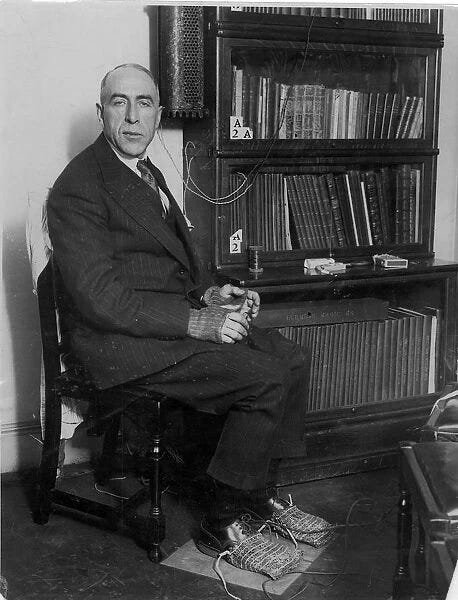
Harry Price in his element, wearing what appears to be fingerless gloves and some foot sacks -probably trying to keep the heating down, cozzie livs.
Harry Price was a bit of a Jack of all trades, a cadaverous looking man who presented himself as an Oxbridge scholar with a scientific background and a real desire to get to the truth. In reality, he was a lower middle-class salesman and magician who never let facts get in the way of a compelling story.
Price immediately knew that he was on to a good thing with Borley, and got to work setting up a series of seances and stake outs in order to communicate with the spirits and find out what the ruddy heck was going on. With Price’s arrival came more spooky happenings – spirit writing on mirrors, stone throwing, and supposed contact from the deceased Rev Bull. There was even a séance with two of Harry Bull’s living sisters, where the spirits seemed to suggest that their sister in law, Ivy, may have been responsible for their brother’s death. Co-incidentally (or, rather, not) the Bull family were engaged in a heated row at the time of the Smith hauntings with Ivy over their inheritance.
The Smith’s decided they’d had enough of these spooky goings on (and the Eastenders-like family drama) and left the rectory in 1930. It’s worth noting that they also wrote a book Murder at the Parsonage, a fictionalised account of some of the rectory’s more scandalous history, leaving us to wander if the whole thing might not have had a hint of a money-making scheme behind it…
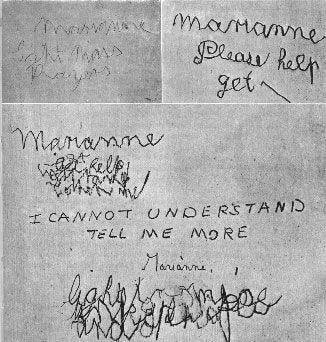
The next rector was a rev Lionel Foyster and his much younger wife Marianne (who he had known when she was a child…yeuch). Their experiences with the ghosts began to take on a more poltergeist-like element – windows were broken, whispered voices where heard, stones were thrown and Marianne was even thrown from her bed. Writing began to appear on the walls, begging Marianne to ‘please help get’ and ‘Get light and mass prayers here’. I think the photographs of the supposed ghost writing freaked me out most of all; my rational brain new they were scribed by human hand, but simply the idea that an unknown entity had scratched them into the wall sent shivers up my spine…
More reporters arrived and articles were written as the phenomena ramped up, but finally, in 1935, the Foysters also left the rectory. In 1937, Price took out a year’s lease on the house and began a series of ghost hunting experiments. He trained and paid laymen to stay in the house overnight, prepped to observe any phenomena that might occur. These were mostly students, and you have to ask yourself how much ‘science’ was really getting done by a bunch of 20-somethings with no psychological background and free access to liquor, supplied by Price.
In 1938, a final séance was held, although in London, not Borley, by Price and a medium called Helen Glanville. Glanville claimed that the ghostly nun was responsible for most of the hauntings, that she was a medieval, French, and she had been buried alive for an illicit tryst with a monk. Another spirit also said he was going to burn down the rectory that very night. ..
And it did. That very night. Give or take 11 months. On 27th February, 1939, the house’s new occupant knocked over a lamp in the library, and soon the whole place was reduced to rubble and ash. That was the end of Borley Rectory.
In the following years Price would attempt to keep the story alive. He claimed to have found the bones of a woman in the ruins (actually those of a pig) and attempted to convince people that a picture of the house showed a brick hovering in the air (actually just thrown by a workman clearing the rubble). Price died in 1948, and the legend all but died with him. Over the next few years much of the haunting would be debunked, refuted or simply revealed to have been practical jokes.
So what is it about Borley that has endured? I think there are several elements that appeal to us today. Firstly, the key elements of Borley play into long-held British beliefs about hauntings – new buildings on ancient grounds, religious upheaval and personal tragedy leaving its imprint on the location. The nun may been inspired by popular gothic tales of the day, all of which relied heavily on the Victorian obsession with purity and scandal. The story also revolves around the lives of several families with secrets and scandals to hide, adding a juicy, gossipy angle to the tale. Henry Bull’s death from possible syphilis adds an unsavoury undertone to his reputation as an upstanding clergyman. His daughters petty squabbles over money led to accusations of murder. The Smiths claims of ghostly torments were undermined by their sordid desire to make a quick buck. And Marianne and Lionel? They had married after he had spend decades as a ‘confirmed bachelor’ and lived with a lodger much closer to Marianne’s age – a lodger it was claimed was actually having an affair with Marianne under her husband’s nose. The stone throwing, fire starting, wall-writing ghost seems to have been a cover for something much more tantalising – good old human desire for money, sex and fame.
Today, claims that Borley church is now haunted are a little confusing…do ghosts move house once their lease is up? Who knows. You can always go and look for yourselves at the remains of Borley. Once night in the 1980s, as a student, my mum and some friends went out to look at the site where the house had stood for a bit of a laugh….of course, there was nothing there except a few bricks and some annoyed locals. But the fact that they went at all is testament to the staying power of the ‘Most Haunted House in England’
Next time: A 17th century magistrate finds himself harassed by a demonic presence in his home…
Eleanor’s Top Ten Hauntings of All Time: #2 The Phantom Drummer of Tedworth
A haunting or a morality tale about treating the homeless with dignity?
Jun 11, 2024
In honour of my Fringe Show Haunted House, I’m doing a top ten real life hauntings run down, and today, its the Phantom Drummer of Tedworth. I think we can all agree that the 17th century has a spooky vibe to it. It’s jam-packed with tragedies and eerie events – the witch hunt, the Civil War, the London plague, Salem. There’s something about those big white collars and curly moustaches that really lends itself to a grave, dark atmosphere. (Not to self: finally get round to watching A Field In England).
I think I first read about this case in Horrible Histories: The Slimy Stuarts. I loved those books as a child, but somehow I remember always skipping past the big about the phantom drummer if I was reading late at night – it was just too scary. Something about glowing red eyes staring out of the darkness…
Sometimes dubbed ‘Britain’s first Poltergeist case’ the phenomena known as the Phantom Drummer of Tedworth is at times a deliciously creepy tale of a demonic haunting, with a surprising foray into the realm of local council administration.
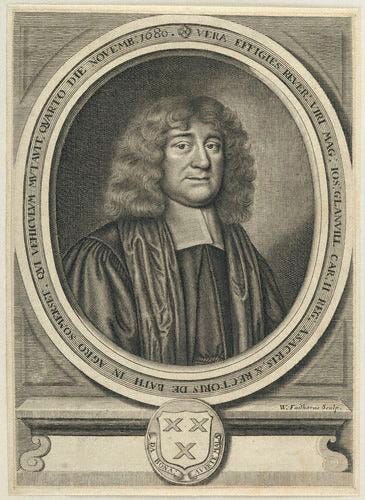
Joseph Glanvill, whose account of the haunting was recorded in his book on witchcraft. He looks like he’s getting a perm at the salon.
Our tale begins in Tedworth, now known as Tidworth, in the English county of Wiltshire, which is also home to Stone Henge and plenty of West Country superstition. According to local clergyman, Puritan Joseph Glanvill, the haunting took place in 1661 – only a year after Charles II returned to the throne. This would have been an uneasy period of spiritual turmoil, political altercations and social uncertainty. The country’s leader and religion had changed yet again, and old and new beliefs mixed together in this new uneasy peace.
Glanvill recorded this tale in a book entitled Saducismus Triumphatus, published 20 years later in 1681, a year after his death. The book is a record of several supposedly true hauntings, apparitions and witchcraft cases, and would go on to directly influence Cotton Mather of Massachusetts in his approach to the Salem witch trials in New England (that is, it convinced him that witches were real and we should definitely hang them)
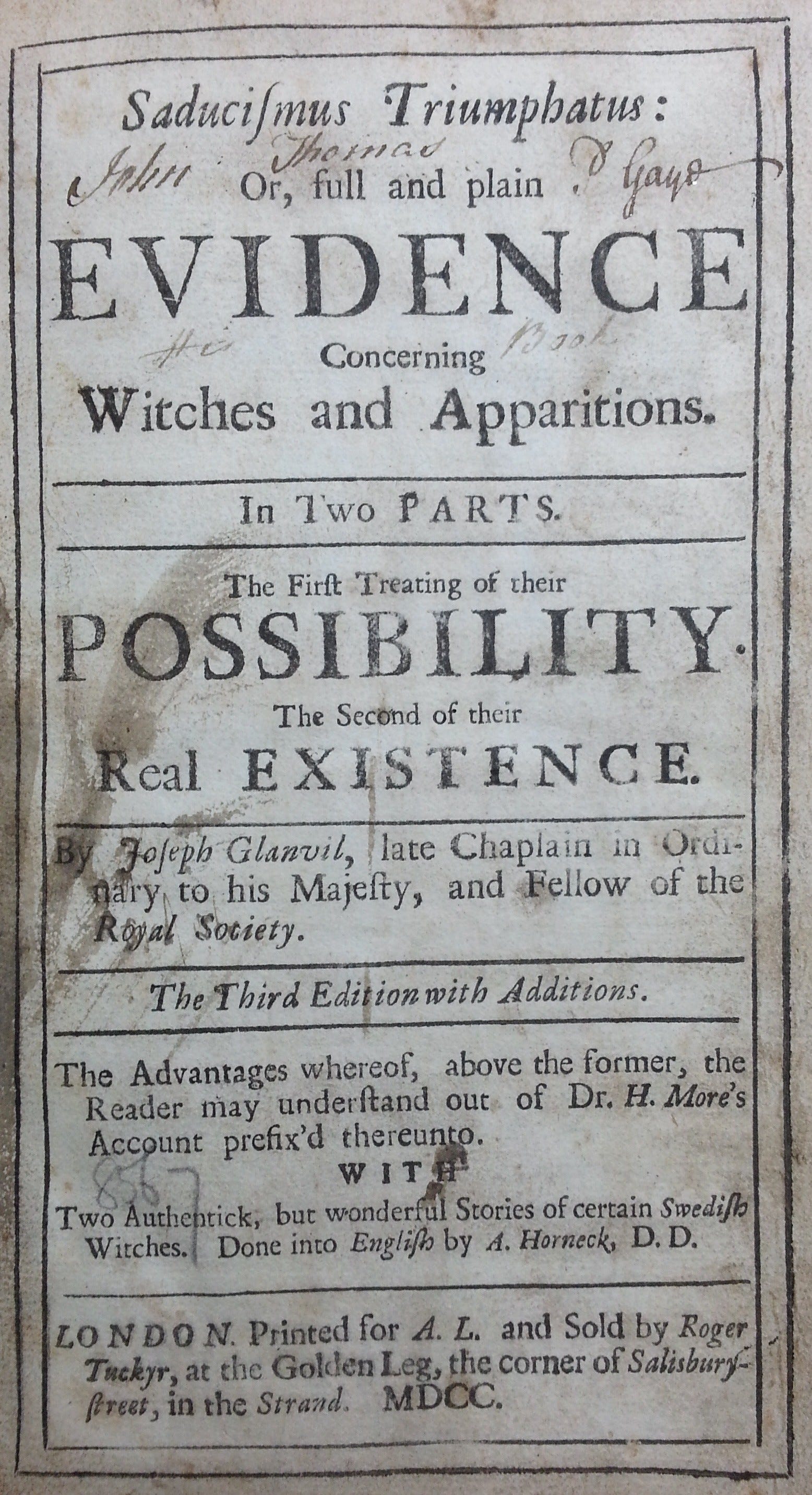
Glanvill’s book, with its characteristically long 17th century title
Back to Tedworth. In 1661, local magistrate and landowner John Mompesson had complained to the authorities about a beggar, William Drury, who was banging a drum to get attention and elicit donations. Mompesson claimed that Drury did not have a licence for the drum, which was duly confiscated and given (for some reason) to Mompesson. It’s a tale as old as time; only a few weeks before I wrote this, a woman busking with a harp was harassed by an older lady insisting she was ‘begging’ and refusing believe she was allowed to be there. (For non British viewers, no, she is not saying ‘Karen Council’, its ‘Harrow Council’, but a Karen Council would be quite a sight)
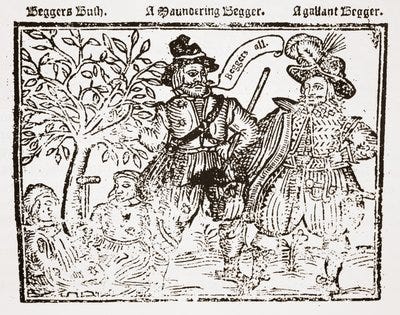
Beggars With That Shakespearian Rizz
Mompesson took the drum home with him, and soon afterwards he and his family began to be plagued by a relentless drumming noise coming from somewhere inside their house. Mompesson, unable to locate the noise directly, would spend hours pacing the corridors, trying to find the source. The drumming ranged from standard banging noises to full military tattoos – according to one witness, it even took requests, suggesting a mischievous spirit at play. The drumming was followed soon after by pretty much every example you can think of from the Standard Poltergeist Textbook. Night after night, the Mompessons experienced:
Rappings, scratchings and the noise of dragging chains
Unexplained fires
Chamberpots emptying themselves
The children’s sheets being torn by phantom hands from their beds
Weird lights
Horrible Smells
Furniture which danced around the room of its own accord
Pairs of glowing eyes peering out of the darkness
An unseen creature that was heard to pant and purr
Coins turning black of their own accord
Glanvill himself claimed to have heard the scratching noises in 1663, but he wasn’t the only notable figure at the time who remarked on the case: in 1667, Chief Horndog of His Majesty’s Navy Samuel Pepys recorded in his famous diary;
“Wife and girl and I alone at dinner – a good Christmas dinner, and all the afternoon at home, my wife reading to me ‘The History of the Drummer of Mr. Mompesson’, which is a strange story of spirits and worth reading indeed.”
John Wesley, the famous Methodist preacher (himself a subject of a haunting during his childhood known as the Haunting of Epworth Rectory’) wrote about it later, claiming his brother had asked the family if the haunting was real – apparently, it had all been a hoax, but by then Mompesson was in too deep to admit it.
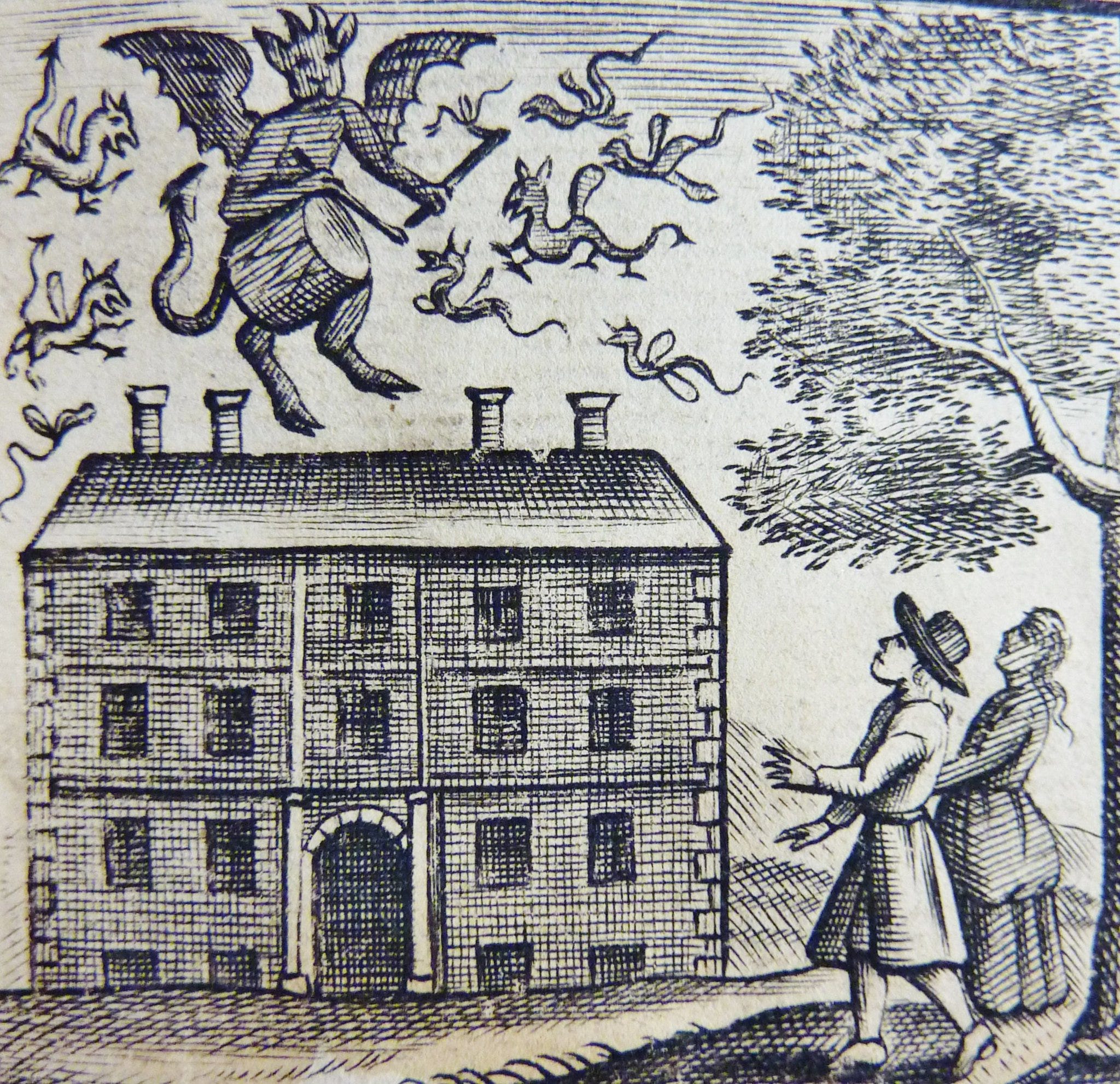
Perhaps the most famous picture of the phenomenon, from the frontispiece of Glanvill’s book. The drummer here seems to be a demon, or the devil himself, surrounded by what appear to be sperm dragons
The hauntings continued for two years, and things escalated further, culminating in the children and servants levitating and being thrown from their beds, and objects violently thrown across the room. A horse died, seemingly of terror, in its stable, and the drumming noise grew so loud it woke the neighbours. A blacksmith was even chased by a pair of levitating tongs, which kept attacking his nose – which, I’ll admit, is a bit too funny to be scary. Curious onlookers were now coming from far and wide to see the ghost for themselves, including the anonymous witness who wrote the below account:
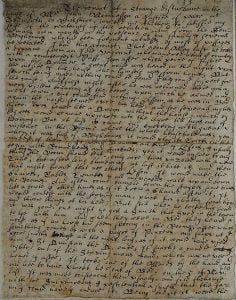
An eye-witness account of the haunting, which you can read here, on the National Archives blog
As the story goes, it turns out that Drury had been locked up in a prison for the entirety of the hauntings, meaning he could not be responsible…unless by some demonic force, which is exactly what he claimed had happened – he was a witch who had set the spirits on the cruel and heartless Mompesson as revenge for taking away his livelihood. He was was due to be transported for theft in 1662, but apparently escaped the ship before it set sail. When he was finally recaptured and transported, the occurrences ceased forever.
What to make of this tale of public nuisance turned demonic? Most sceptics agree that the majority of the haunting was carried out by Mompesson’s own children, no doubt looking for a bit of attention and trying to stave off the boredom of living in 1660’s England. It might seem silly to us that a scholar and philosopher like Glanvill, an Oxbridge graduate, could be taken in by this, but it’s worth remembering most of our current cabinet also went to Oxbridge. It is, therefore, not much of a defence against stupidity. What I feel is the most likely cause for Glanvill’s belief in ghosts and demons is (alongside his strict Puritan upbringing) his living through an unstable and sometimes terrifying period of history, where the rules of right and wrong, of up and down, of good and bad where thrown out of the window. Statistics show that reports of ghosts always spike during a time of crisis, like WW1, WW2 and, more recently, the Covid pandemic. Glanvill was, like all of us, looking for reason in an unreasonable world.
More interesting, I think, is the clash between Drury the beggar and Mompesson. Mompesson’s attitude to the beggar reflected many of the time and yet, despite his wealth and privilege, he did not go unpunished for his cruelty, perhaps serving as a morality tale to the reader about the importance of Christian charity. Today many people still see buskers and beggars alike as a noisy, annoying eyesore. It’s perhaps worth remembering that they deserve the same respect and dignity as everyone else. If only because, if you’re not nice to them, they may well set a demon on you.
Eleanor’s Top Ten Hauntings of All Time: #3 Hinton Ampner or, The Haunted House You’ve Never Heard Of
This weeks haunted house is a lesser known story about the dangers of renting…
Jun 18, 2024
In honour of my Fringe Show Haunted House, I’m doing a top ten real life haunted houses run down, and this time, we’re in Hampshire in England for a lesser known (but no less frightening) tale of a haunted house that eventually became unliveable.
My source for much of today’s tale is the excellent A Natural History of Ghosts by Roger Clarke, which I absolutely love and have read over and over again – highly recommended if you’re interested in the cultural and social impact of ghosts.
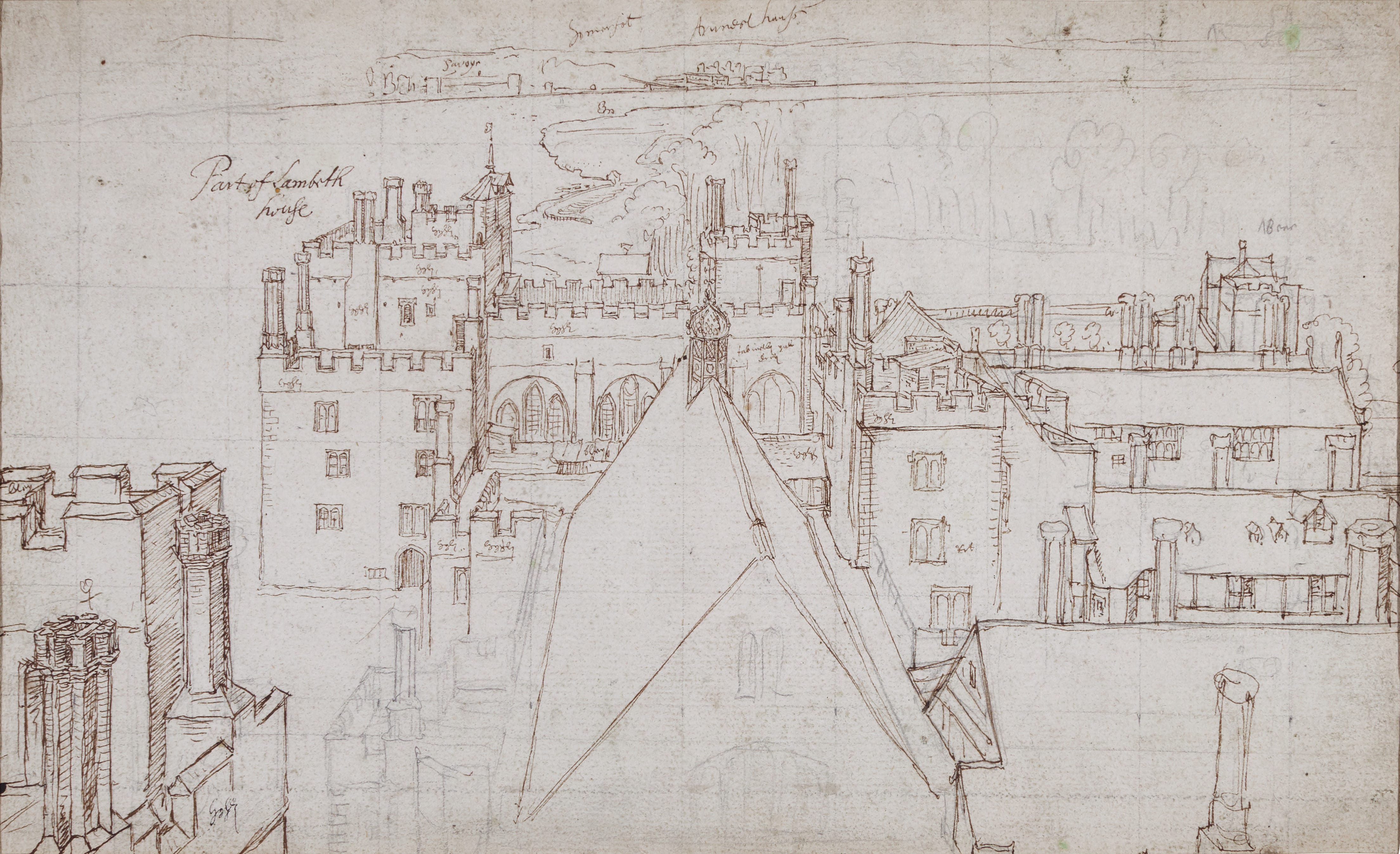
A 17th century sketch of Lambeth palace, a Tudor house
Hinton Ampner, which sounds like the name a Hollywood film might make up for a fictional spooky village, is a real life spooky village with a very nice 18th century National Trust property you can visit today. It’s an airy brick building in the Georgian style, and over the years its been home to countless aristocrats, suffered from fire damage, and even became a girls school during WW2. This house, however, was in fact built to replace the original Hinton Ampner manor, a 16th century Tudor property that stood a few hundred yards from the modern manor. It was in this original house that our haunting took place.
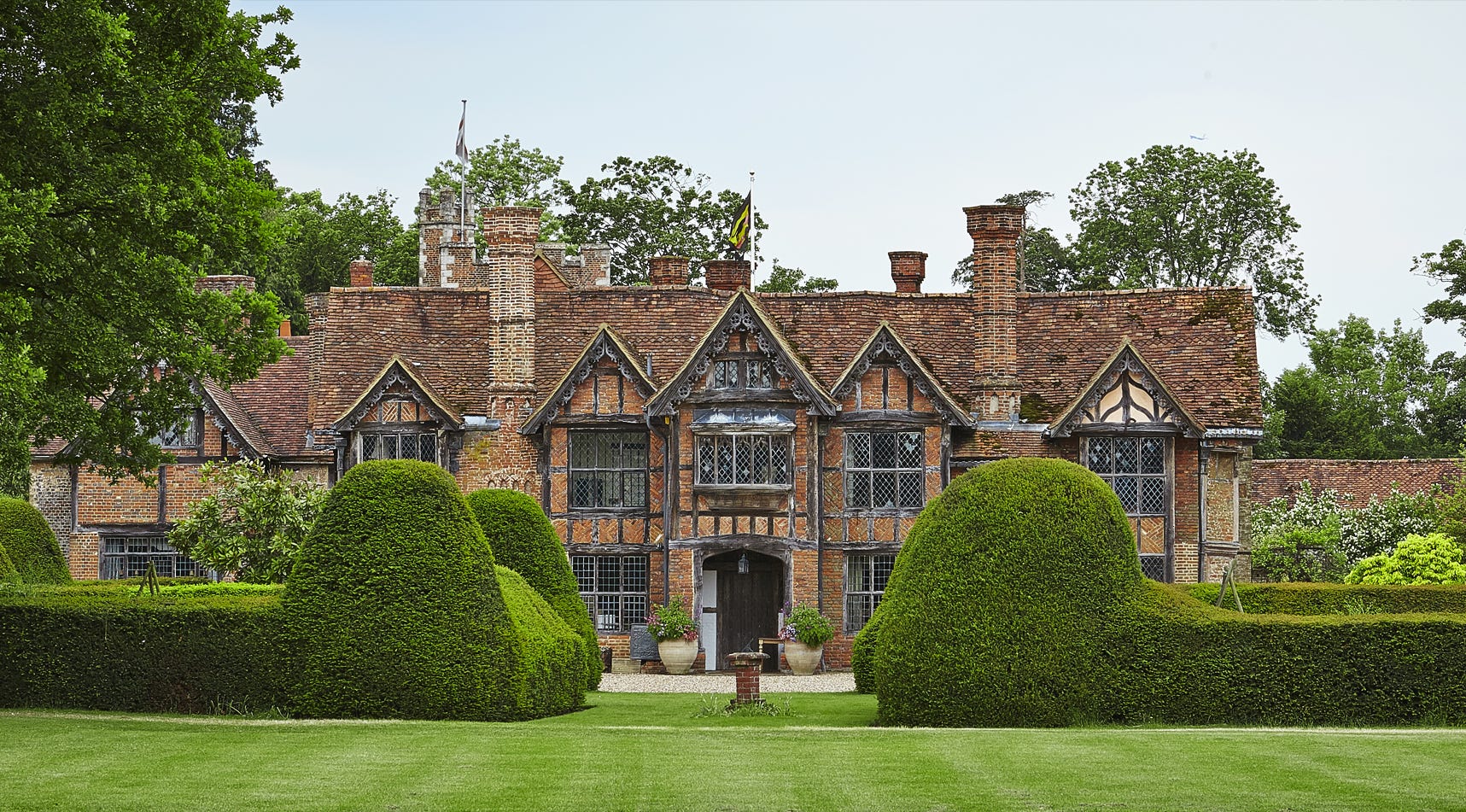
Dorney Court, (not Hinton Ampner), which might give you an idea of what the original house may have looked like
In 1764, a Mr and Mrs Ricketts (who’s name comes from the Charles Dickens book of Naming English People) moved into Hinton Ampner, renting it from its owners (Yes, its absolutely baffling to me that rich people rent property, but there we go) for themselves and their two month old son. Mary and William had met in Jamaica, where the Ricketts, like many a well off Georgian merchant, had made their money in the plantations – in other words, they were slave owners.
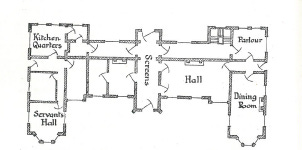
A Tudor floor plan resembling the house’s alleged ‘E-shaped’ outline.
The hauntings began almost immediately after they moved in – loud banging noises, doors slamming, footsteps throughout the night. Mary, whose writings on the case have given us much of the primary evidence on the haunting, recorded that ‘soon after we were settled at Hinton I frequently heard noises in the night, as of people shutting, or rather slapping doors with vehemence’.
The noises became so frightening (and, I imagine, annoying) that Mr Ricketts had all the locks changed, convinced that youths from the village where breaking in and mucking around. This had no effect however, and the noises continued. Animals in the house showed signs of freaking out for no particular reason. The ‘Yellow bedroom’ was especially haunted, and in June, a nursemaid saw a man in a ‘drab-coloured suit’ go into the room. When she asked another servant who he was, and both realised neither knew what was happening, they searched the house, and found no one.
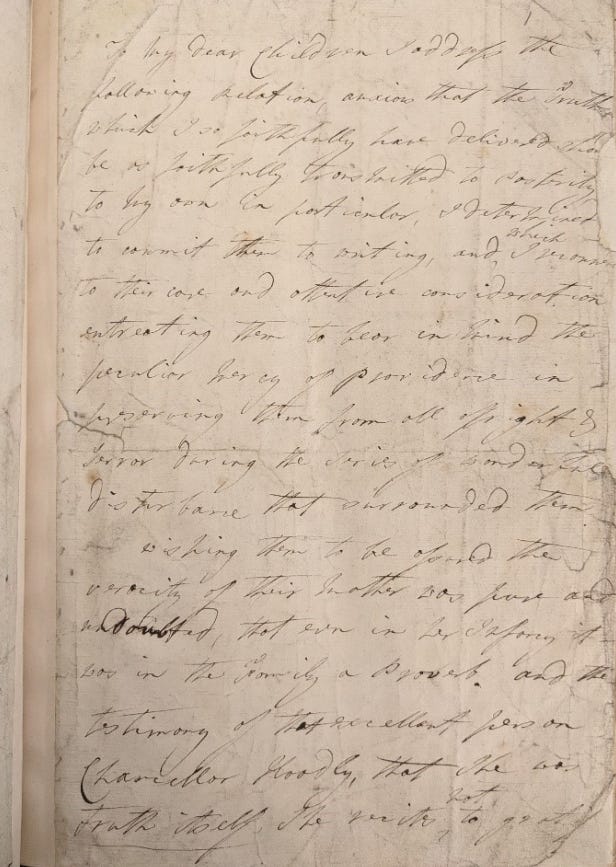
A page of Mary’s diary recording the haunting, from a blog by the British Library
More sightings of the ‘drab’ man followed, and another ghost was seen in July 1767, in daylight, by four people. According to the four servants, who were in the kitchen at the time, they heard the rustle of a silk dress and saw a tall woman enter the room, vanishing when the cook came in.
And so the disturbances continued until November 1769, when William Ricketts was called back to Jamaica on business (that business being the buying and selling of human beings). Mary was now alone in the house (aside from her three children, cat and various servants) and she felt apprehensive. Initially she had brushed off the phenomenon as working-class superstition on behalf of her servants, but now she wasn’t so sure.
As well as the heavy footsteps and knockings, Mary was now kept awake by the distinct and loud sounds of a silk dress rustling in the corridor outside her door, which would vanish the instant she went to investigate. I’m not sure how a dress can rustle loud enough to keep someone awake, but that’s what Mary claimed, and interestingly, my own mum’s one ghostly experience also involved the rustle of silk dresses of a supposed Georgian ghost.
The staff had begun leaving by this point (although this might not actually be connected with the ghosts, maybe she just didn’t pay very well) and soon they had been completely replaced by new servants. The terrifying occurrences included an evening when Mary, sleeping in the Yellow room one night, heard the sounds of a man’s footsteps approaching the bed in the dark. Even without a supernatural origin, that’s a pretty scary noise. Mary was determined not to be intimidated by these noises, although she did move to the ‘Chintz’ room, where she claimed to hear music and crashing noises.
Perhaps the creepiest episode came next – whispering. ‘I was frequently sensible of a hollow that seemed to possess the whole house…it was independent of wind, being equally heard on the calmest nights’ Mary wrote. It sounded, apparently, like dozens of people all whispering at once.
Mary was struggling to sleep – she moved from room to room, on one occasion rushing to the front door which sounded as if someone was hammering on it with tremendous force. By midsummer 1771, according to Clarke ‘She could now distinguish different people talking. There was a woman with a shrill voice, and two others, men, one with a deep tone’ as well as ‘Sounds, like music but not music’ emanating from some unknown source.
Later that summer, Mary’s brother John Jarvis came to stay. She admitted to him that odd things had been happening, although it wasn’t until he’d left again, in early August 1771, that the worst of the disturbances occurred – at three o’clock one morning a noise that sounded like someone was ‘being dragged to hell’ took place in the house, ‘A shrill and dreadful shriek’ according to Mary, which ‘repeated three or four times growing fainter as it seemed to descend, till it sank into the earth’

John Jervis, Mary’s brother painted around the time of the haunting.
Jervis returned, and, seeing that the haunting had made his sister ill with stress, decided to bust some ghosts. Jervis and his servant went through the house with a fine tooth comb, confident he was going to catch a village trickster or local youth and put the ghosts to rest once and for all. However, like his normally rational sister, he was baffled when he could find no explanation for the continued banging, rustlings, footsteps and door slamming. Mary, at least, was relieved – now she had credible eye-witnesses to her ordeal. Obviously, servants were not considered credible.
Jervis wrote to William Ricketts and declared that the house was unfit for his sister and her children to live in. Jervis was also doing some research – he discovered the house was infamous locally for being haunted, and that the hauntings seemed to have their origin with the previous owners, in particular Edward Stewkeley, Lord Stawell, who was rumoured to have started an affair with his sister-in-law after his wife’s death. It was his niece, Lady Hillsborough, who currently owned the house. According to local legend, Edward and Honoria, the sister-in-law, had a baby, which was then smuggled away in the dead of night to avoid scandal, by a servant, Isaac Mackrell, who smothered it and buried it on the property. Could it be his ghost in the drab coloured coat, replaying his role in carrying out Edward’s dirty work? Or was the ghost Edward himself? And what of the female ghost in the rustling silk? Was it Honoria, looking for her stolen baby?
The Ricketts finally moved out that same year, and in 1772 another family, the Lawrences, moved in, although they were out again within the year. Their servants had been specifically instructed not to mention any ghosts, but it didn’t seem to help the Lawrences avoid them. Mary visited the house only one more time after leaving for good, and was once again plagued by terrifying noises.
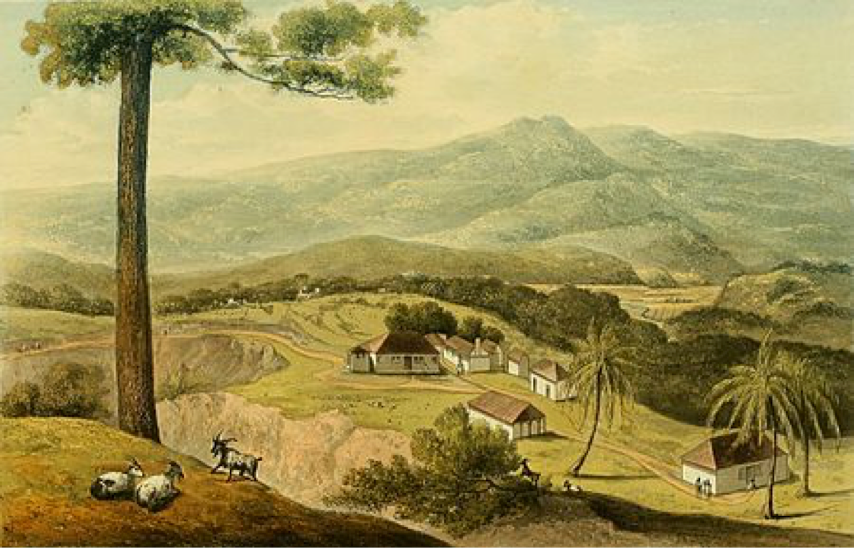
A plantation in 18th century Jamaica, similar to the one where the Ricketts made their fortune
In 1797 the house was pulled down, leading to one final horror – the body (or skull, its not entirely clear) of something ape-like (a baby?) was allegedly discovered beneath the floorboards. On hearing of this Mary immediately linked it to the legends she had heard about Lord Stawell and Honoria. Mary lived most of the rest of her life near Hinton, and would eventually write down the record of the hauntings for posterity as well as her children (who, curiously, were completely immune to the hauntings).
So what really happened at Hinton Ampner? It seems pretty straightforward – a house is haunted by a murderer, a tragic mother and their sordid love affair, finally put to rest when the house was demolished and their baby’s body uncovered. But this narrative is almost a little too neat. Is that all it is? Perhaps the haunting is older, and dates back to nearby Civil War battles? The case is well documented by some pretty well respected people (John Jarvis had a long and illustrious naval career), and there is something fascinating about slave owners being horrified by a few bumps in the night, but not their own contributions to human suffering. It’s a bit of a microcosm of the messy realities of wealthy Georgian Britain and it’s ties to the past, and that’s probably part of what makes it compelling. If I was to write a film about this, I’d probably insert some sort of trauma-themed metaphors for the Ricketts being tormented by their own sins (their children, innocent of any wrongdoing, are untouched) but maybe that’s a bit on the nose. Either way, the Hinton Ampner haunting has to be up there as one of the UKs most credible and fascinating cases. And it should also serve as a reminder that you only have to give your landlord a month’s notice if you’re being tormented by spirits and want to move.
Next time: a lesser known Scottish poltergeist terrorises a family in turbulent times
Liked this? Support me on with the price of a coffee here
Eleanor’s Top Ten Hauntings of All Time: #4: The Mackie Poltergeist
In honour of my Fringe Show Haunted House, I’m doing a top ten real life haunted houses run down. Number 4 is the Mackie Poltergeist of Galloway…
Jun 25, 2024
The whole reason I’m doing this show is because I grew up in the (apparently) ‘spookiest country in the world’. Scotland is an undeniably ghostly country – we were carving neeps, guising and celebrating Hallowe’en long before candy corn and trick or treating existed. No, NOT Samhain – Halloween (Yes, this is a pedantic pet peeve of mine).
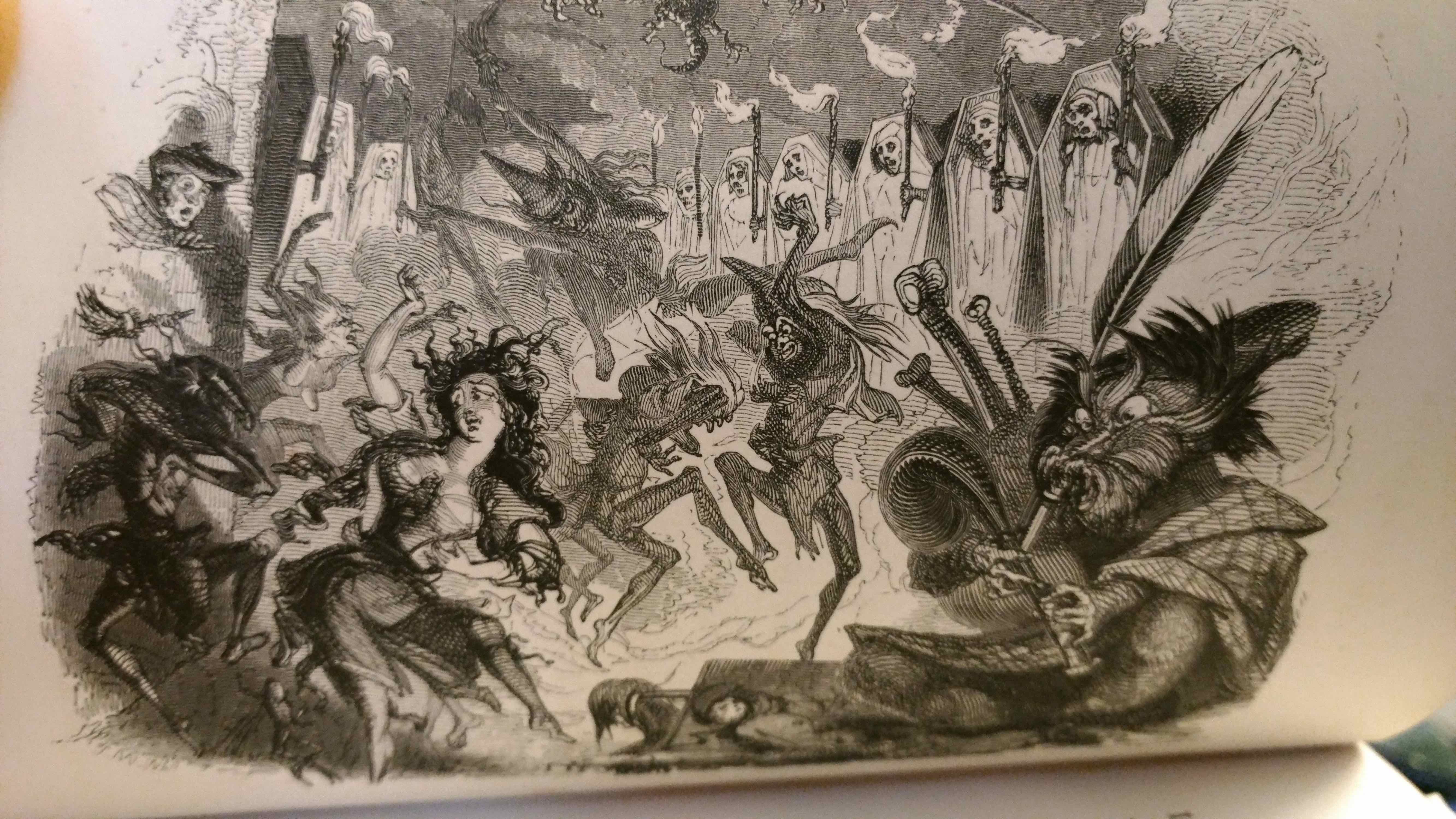
An illustration of Robert Burn’s classic Halloween poem, ‘Tam o’ Shanter’, showing a standard night out in Scotland
So where better to go for a ghost story than the Birthplace of Scotland’s spookiest poet, Galloway (Ok, ok he’s from Ayr, we’re in the right general area, now who’s being pedantic?) And to the farm of Andrew Mackie, farmer and victim of an apparent haunting. My sources today include my old Lomond Books ghost stories, this excellent blog, and this Scots magazine article.
Our story begins in February, 1695, near the small town of Kirkcudbright, in the parish of Rerrick. Helpfully, it was recorded by the local minister, the Rev Alexander Telfair, who, just like Joseph Glanvill, was astute enough to make note of his observations in a suitably long-titled pamphlet: A True Relation of an Apparition, Expressions, and Actings of a Spirit, which infested the House of Andrew Mackie, in Ring-Croft of Stocking, in the Paroch of Rerrick, in the Stewartry of Kirkcudbright, in Scotland.
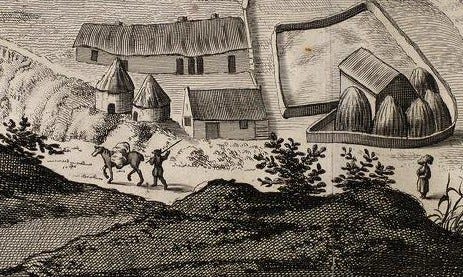
An early modern Scottish farm, perhaps something like Mackie’s
According to Telfair, Mackie came to him asking for divine intervention after unseen hands had disturbed his household for several days. Firstly, Mackie found his cattle had been let loose during the night – he assumed it must be vandals, but every time he tied them up again, and even when he moved them, they were found in the morning with their bindings broken once more.
This might not have seemed particularly spooky, but soon afterwards, activity began in the house: fires were started, and by March, something was throwing stones at the windows of the house, apparently increasing in frequency on Sundays. What’s more, these stone throwings were witnessed by several different people.
Acting on Mackie’s pleas for help, Telfair himself visited the house. Telfair endured stone throwing during his visit, although he was not actually harmed. He then spent a restless night in the Mackie residence, where he was pelted with several objects (including more stones), and rapping noises were also heard.
He also witnessed one of the very few apparitions in the case:
That night, as I was once at prayer, leaning on a bedside, I felt something pressing up my arme; I casting my eyes thither, perceived a little white hand and arm, from the elbow down, but presently it evanished. It is to be observed, that, notwithstanding of all that was felt and heard, from the first to the last of this matter, there was never any thing seen, except that hand I saw…
Apparently, the people of Rerrick were masochists, because soon the house was full of people being abused in some way or another by the ghost: A local miller was grabbed by invisible hands, and had to call for help. A blacksmith was struck on the head with a large stone. Furniture was seen to move around the house, as if carried by invisible hands, and the children were stripped of their clothes whilst lying in bed (Telfair’s document says ‘clothes’ but he might be referring to bed clothes, as in the sheets and covers)
It also started to make human noises. According to Telfair:
At night it cryed Wisht, wisht, [Shh! Shh!] at every sentence in the close of prayer; and it whistled so distinctly, that the dog barked, and ran to the door, as if one had been calling to hound him.
There is something about the image of a dog, in the dark of a rural Scottish night, hearing a whistle from outside, only to run and discover nothing there…
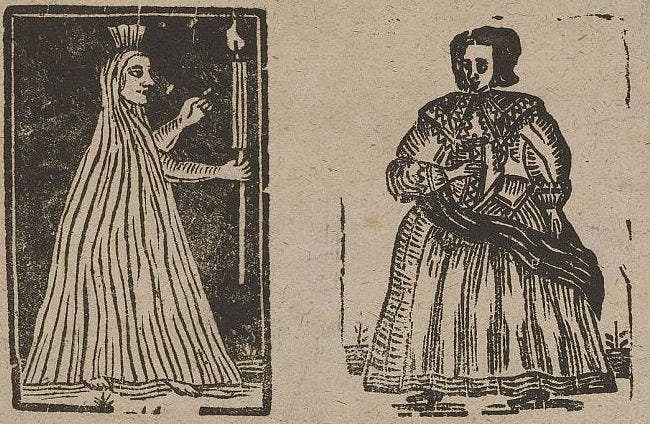
A woodcut from 1680’s England, depicting a woman seeing an apparition
More terrifying nightly disturbances came: one of the Mackie children saw a blanket, huddled by the fire – when they approached and pulled the blanket away, there was nothing underneath.
Eventually, in April 1695, Telfair called in the help of two more ministers, Andrew Ewart and John Murdo. The three spent a night in fast and prayer (sounds super fun) and were mercilessly tormented by the spirit the entire time – stones and sticks beat at them, and more fires broke out.
One day in early April, Andrew Mackie’s wife lifted a loose stone in the doorway and found underneath what seemed to be bones, flesh and fresh blood wrapped in cloth. Scared, and wondering if there was a connection between her grisly finding and the haunting, she removed the bones to the landlords house.
This only made everything worse – the activity increased, with hot stones being found in the children’s bed, and more rock throwing than ever. When Mrs. Mackie returned the bones and Telfair prayed over them, he was beaten with a stick by unseen hands.
Then, according to Telfair, Mackie found a note, ostensibly written in blood, which read:
‘3 years thou shall have to repent a nett it well, and within was written: Wo be to thee Scottland, Repent and tak warning for the Door of hauen ar all Redy bart against thee I am sent for a warning to thee to flee to God, yet troublt shallt this man be for tuenty days and 3,repent repent repent Scotland or els thou shall.’
TLDR: Be more religious by May 1st, or Andrew Mackie’s gonna get even more trouble
Convinced that the bones must have something to do with the haunting, Mackie and all previous tenants were asked to touch the bones. After that did nothing, five ministers went to the house and did some more praying, which, as usual, really pissed off the ghost, who started hoisting people into the air and throwing more stones. They continued to pray for three days, during which time the ghost hurled a dead polecat, brought in by a visitor, around the room. Gross. This was accompanied, as usual, by whistles, stone throwing, and invisible hands grabbing at peoples bodies and clothes.
On the 16th of April, Mackie and his family, exhausted, moved out. They tried to move back in a few days later, after the activity apparently stopped, but it was no use. It was just as bad as before.
Then the spirit began to converse. It insisted it was there to make Mackie and co repent, and that Mackie only needed to worship it, and it would go away. Mackie didn’t fancy this, and instead asked God to deliver him from the Devil, to which the spirit replied, rather sassily;
You might as well have said Shadrach, Meshach and Abednego
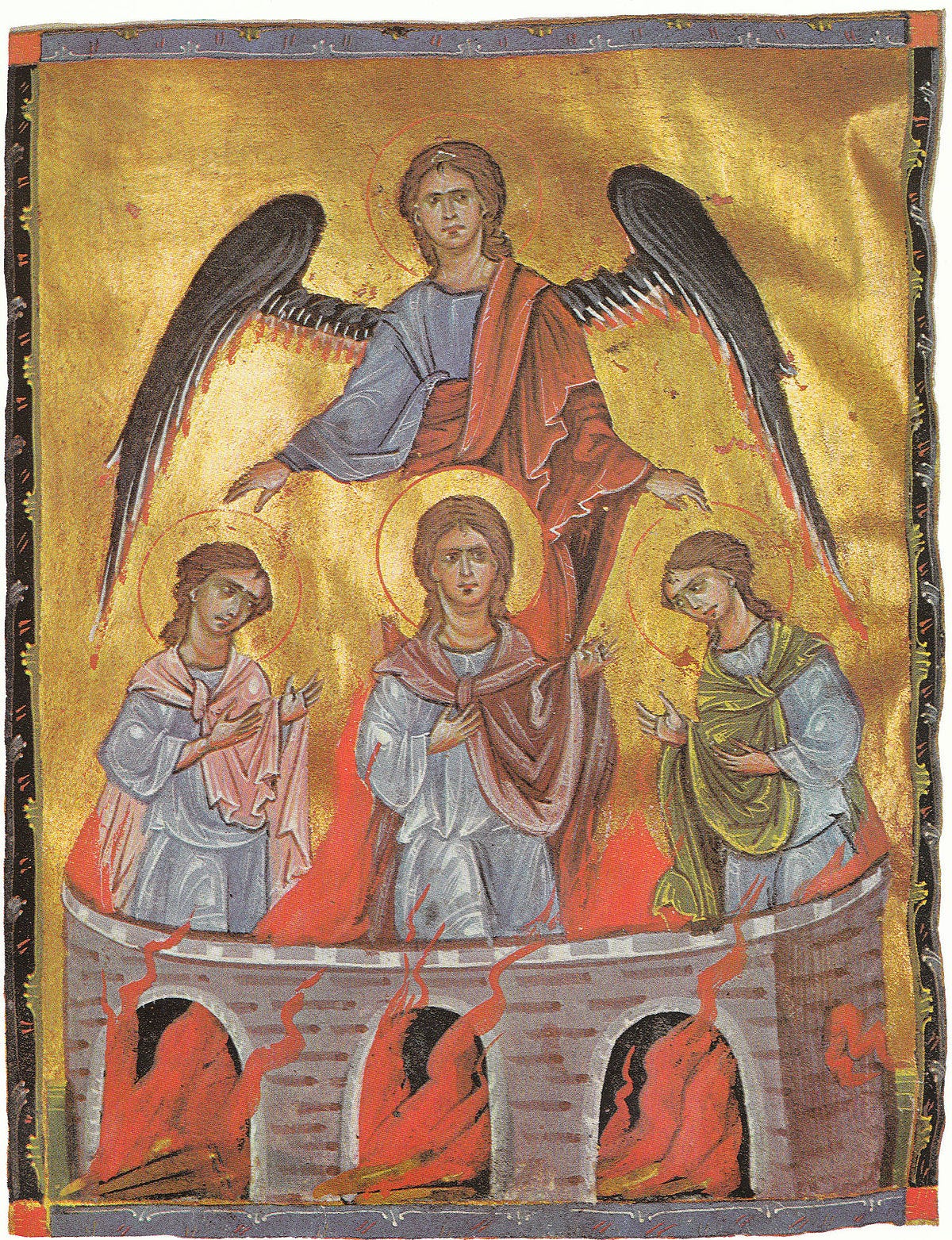
The bois Shadrach, Meshach and Abednego, not taking shit from no false god
This conversation was apparently witnessed by several people. More of the same harassment followed, until, on Tuesday (the day the spirit had promised to stop annoying them) Mackie, praying with his family in the barn, saw a great black cloud begin to fill the room. After that, and one more fire, the disturbances stopped. Everything returned to normal.
Telfair’s document then lists the names and occupations of the witnesses: five ministers and several local men.
So what happened in the Mackie household? Telfair had three theories:
Firstly, the house had previously been occupied by a man named McNaught. He asked a fortune teller for help with his poor health, and her advice was to burn a tooth found under a threshold stone. However, McNaught was already dead by the time her message was relayed to him. A later tenant supposedly did find and burn the tooth, and everything was hunky dory for him.
Secondly, a woman of ‘ill repute’ (likely a beggar, possibly with witchy undertones) had apparently left some belongings in the house before she died, which Mackie was accused of stealing for himself. He strongly denied this, but the Telfair seems to be implying that Mackie had been cursed by the witch’s spirit.
Last and by no means least, Telfair speculated (and then immediately dismissed) the idea that Mackie, on becoming a mason, had sold his first child to the devil.
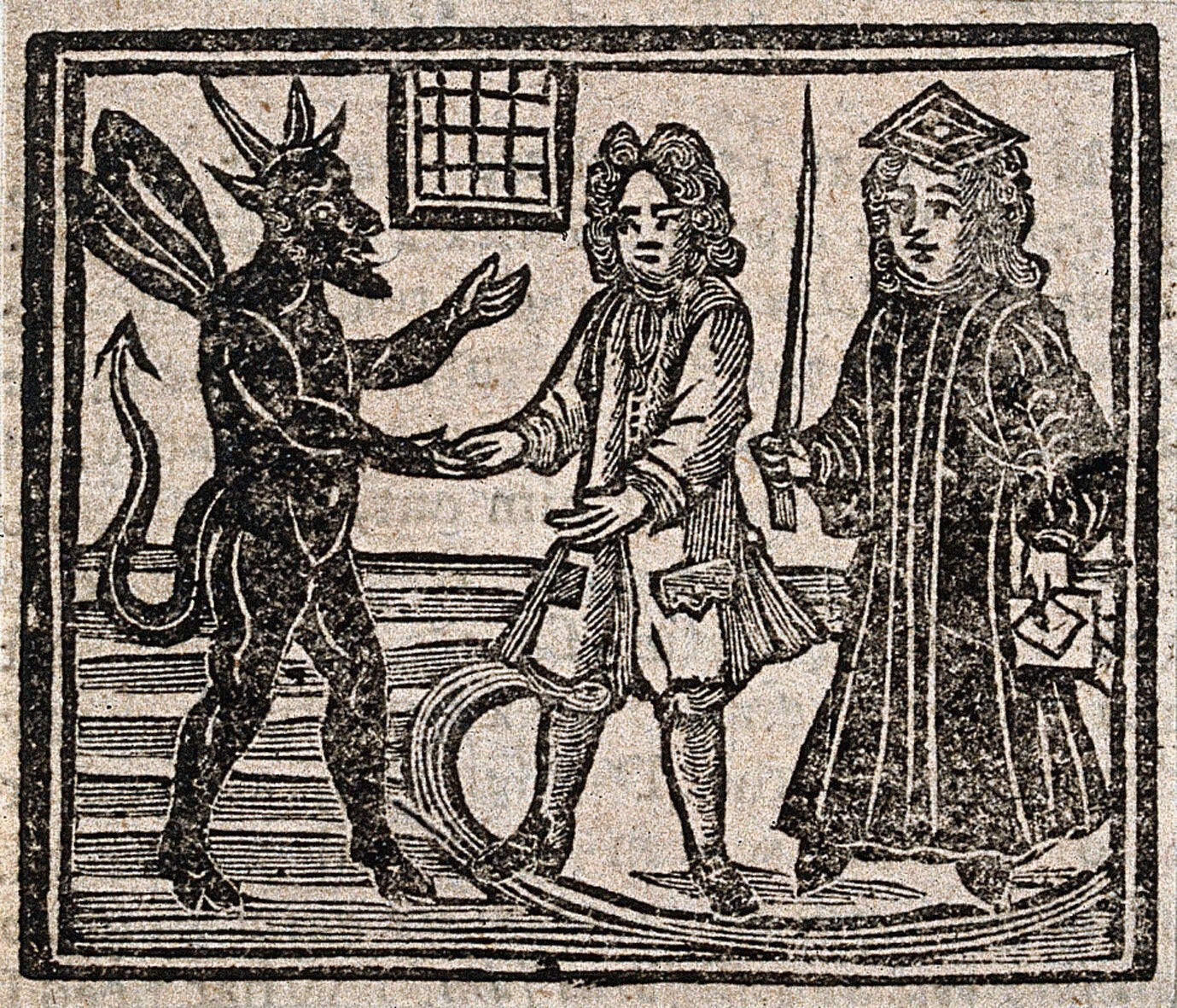
A woodcut showing the devil (probably in the guise of a hedge fund manager) introducing himself to some townsmen. Did Mackie give his child to the devil?
On the surface, there isn’t much to separate the Mackie poltergeist from the three previous cases we explored. Poltergeist activity, including voices, writing and object throwing, all of which suddenly ceases for no apparent reason.
I’m most interested in the voices – in cases where disembodied voices are heard, no one ever seems to record where exactly they seem to be coming from, or whether they sound male or female. The stone throwing, too, is interesting: out of all ghostly actions, stone throwing is probably the one thing a human hand could reasonably get away with hoaxing. And what about the family? Did the haunting cease when they left because they were the focus? Or were they (and their children) the cause?
However, I think there is one thing that marks this tale out from the others so far: the presence of religion. Even in the case of Borley, a haunted Rectory, there is little mention of prayer or God as a way to stop the hauntings. Praying, fasting and attempting to exorcise the ghost are completely absent from Hinton Ampner, Borley and Tedworth, the latter of which took place only a few decades previously.
I think there’s a simply reason for this: despite its religious turmoil, England experienced nowhere near the intensity of the reformation in Scotland. The Scottish Reformation was an incredible upheaval and the fallout lasted several hundred years. Most notable, only a few years before this case took place, the Covenanters, a group of devout Presbyterians, had been hunted down and executed for their beliefs, with as many as 18,000 dying, in a period known as the ‘Killing Time’. Covenanters were still being imprisoned as late as 1688. Only 10 years before the haunting, one of the most gruesome executions of The Killing Time took place, as covered in The National:
Perhaps the worst atrocity took place in Wigtown in May 1685, where two women, 63-year-old Margaret Maclauchlan and 18-year-old Margaret Wilson, refused to take the Abjuration Oath. They were tied to stakes on the Solway sands and drowned when the tide rose.
Covenanter preacher Alexander Peden was even linked to another poltergeist case that took place nearby in the 1660s, the so-called ‘Devil of Glenluce’
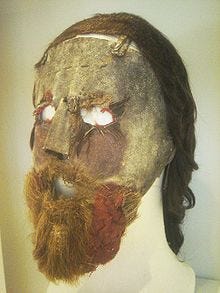
Alexander Peden’s mask and wig he wore to preach whilst on the run
It’s easy to see then, in a rural community where you were commanded to “Lufe God abufe al and yi nychtbour as yi self” that Mackie should face such an ordeal at the mere suggestion he might have been slacking on his religious duties.
It’s also important to note that Telfair uses the pamphlet as an argument against atheism; ie, he shows us the dangers of neglecting our holy beliefs and prayers. Perhaps, then the Mackie Poltergeist is little more than Presbyterian propaganda.
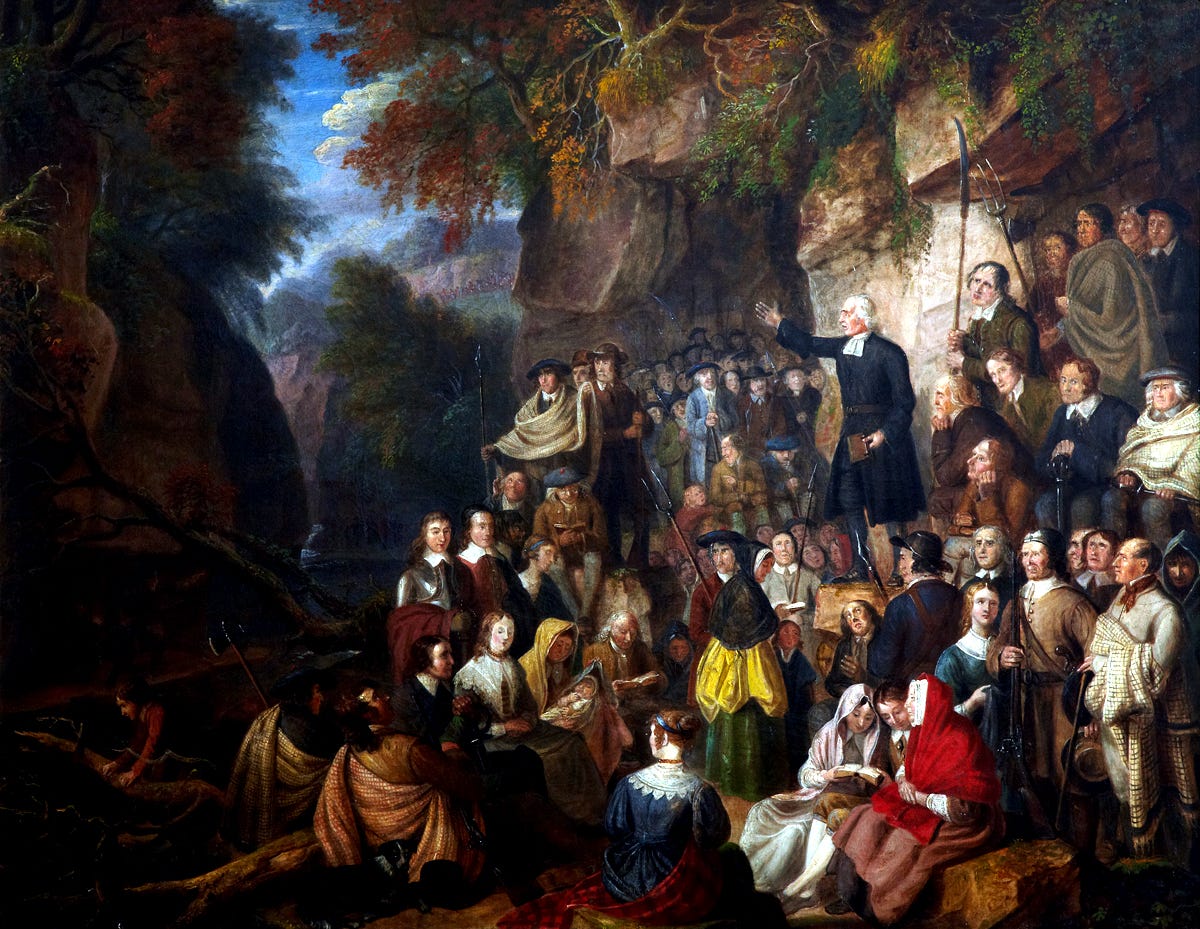
An 18th century painting depicting an illegal Covenanter prayer meeting
Next time: Faces in the floor in Spain…
Liked this? Support me on with the price of a coffee here
Eleanor’s Top Ten Hauntings of all Time | #5 The Faces in the Floor or Caras de Bélmez
Franco’s Fascist Floor Faces Feel Fortean – Fact or Fiction?
Jul 02, 2024
In honour of my Fringe Show Haunted House, I’m doing a top ten real life hauntings run down, and at number 5, we’re off to the continent for a very unique case…
The Bélmez Faces, as they were known, are a staple of any weird phenomena book published in the last 50 years, and whilst the story itself doesn’t seem particularly frightening, I think it was the images of the faces themselves that made the hair on the back of my neck prickle as a kid. My limited experiences of Spain were sunny summer holidays, not very spooky at all, but like all Catholic countries, the Spanish go absolutely ahem, loco, for ghosts.
The story takes place in Bélmez, in Andalusia, southern Spain, beginning in 1971. 52 year old housewife María Gómez Pereira claimed in August that year that what seemed to be human faces had begun to appear, by themselves, in her concrete kitchen floor. At first, they appeared as stains, which María could not remove. Then, they morphed into crude drawings – some more than a few lines, but their likeness to human faces was quite apparent.
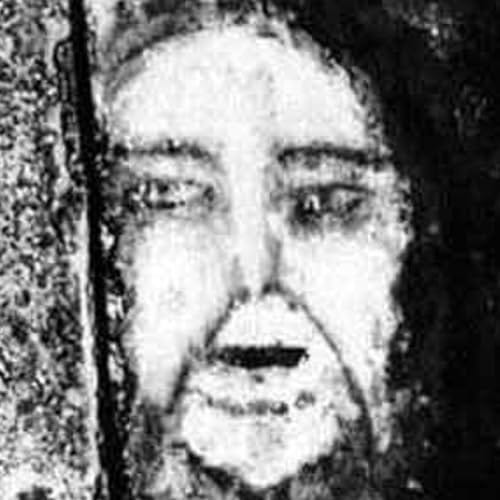
One of the images of the faces I saw in books as a child. Nasolabial folds were, for some reason, a distinct part of these images, making the faces look old and tired.
According to this article by Gerhard Mayer at Research Gate, at first Maria was not particularly bothered by the faces, but her son was – he destroyed the first one and covered up the area. However, more faces started to appear, and soon everyone in town was talking about it – even the mayor. Locals and tourists alike began travelling to the house to see the ‘Belmez Faces’ María’s family even had the entire floor removed and replaced- but to no avail. The faces continued to appear.
This was not the first or last time in Spanish history that tourists would flock to see a supposed miracle. In fact, there are so many places of pilgrimage there that you can even check out this website and see which one you fancy visiting. Lourdes, perhaps one of the most famous pilgrimage sites in history, is only just over the border in France, a few hours drive from Pamplona. Obviously, Bélmez is not near either of these sites, but my point is the whole region of Mediterranean Europe is chocka with holy sites, miracles, relics and sacred places. The Spanish must have thought nothing of popping by to take a quick look at these faces. Some thought they were a sign from god – others, a sign of the devil. Either way, they were big news.
The mayor was alarmed at the commotion the faces were causing – there were rumours of a demonic presence in the house, and he insisted that the site was excavated as a way to get rid of them. The faces continued to appear in the first year at about one per month, sometimes in the presences, apparently, of witnesses, sometimes on their own.
Eventually, the floor was dug up to see exactly what was causing it, and human remains (though not skulls) were found underneath. They were then reburied in a proper religious ceremony elsewhere. In a straightforward ghost story, this would have been enough to put the faces to rest, but they continued to appear.
Creepily, the faces also appear to change over time –
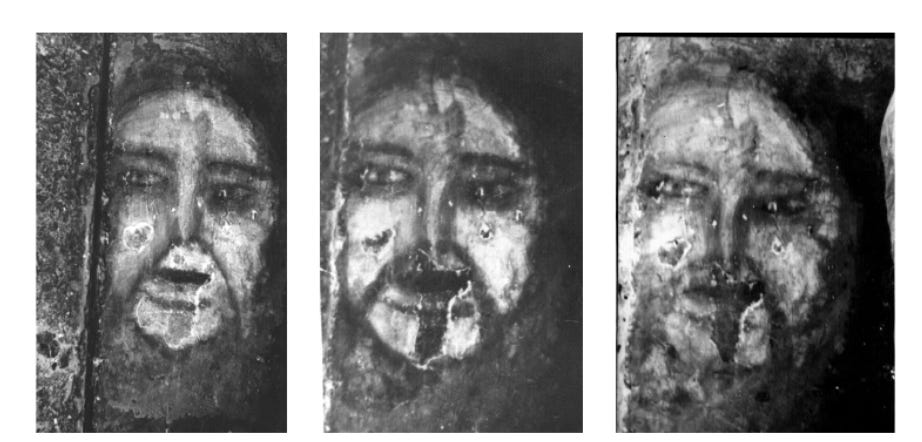
Changes in the second face over a period of months – it’s mouth appears to open and then close again. It also looks like it might be wearing an England flag face paint – ready for the Euros?
Lots of scientific experiments to determine the cause of the faces were conducted, and the area was sealed off, covered up or guarded. But this did nothing to hinder the faces, who, just like the first, appeared first as a stain and then gradually formed into human features.
German ghost-hunter Hans Bender (don’t be juvenile) conducted an experiment whereby he planted microphones around the kitchen, trying to pick up noises of people creating the faces. What he got (apparently) was spooky voices coming over the recording, voices which;
María died in 2004, aged 85, and apparently the faces are still appearing to this day. You can even visit them! In fact, some of them have even started to appear in the house where María was born too…Of course, many people have speculated that María and her family were simply trying to make a quick buck (they wouldn’t be the first in history to fake a haunting), but the question here is – was it worth it? Apart from having strangers tramping in and out of her kitchen all day, and getting a telling off from the mayor, María doesn’t seem to have benefitted much from the faces. She became well known, but not rich, much studied but never vindicated.
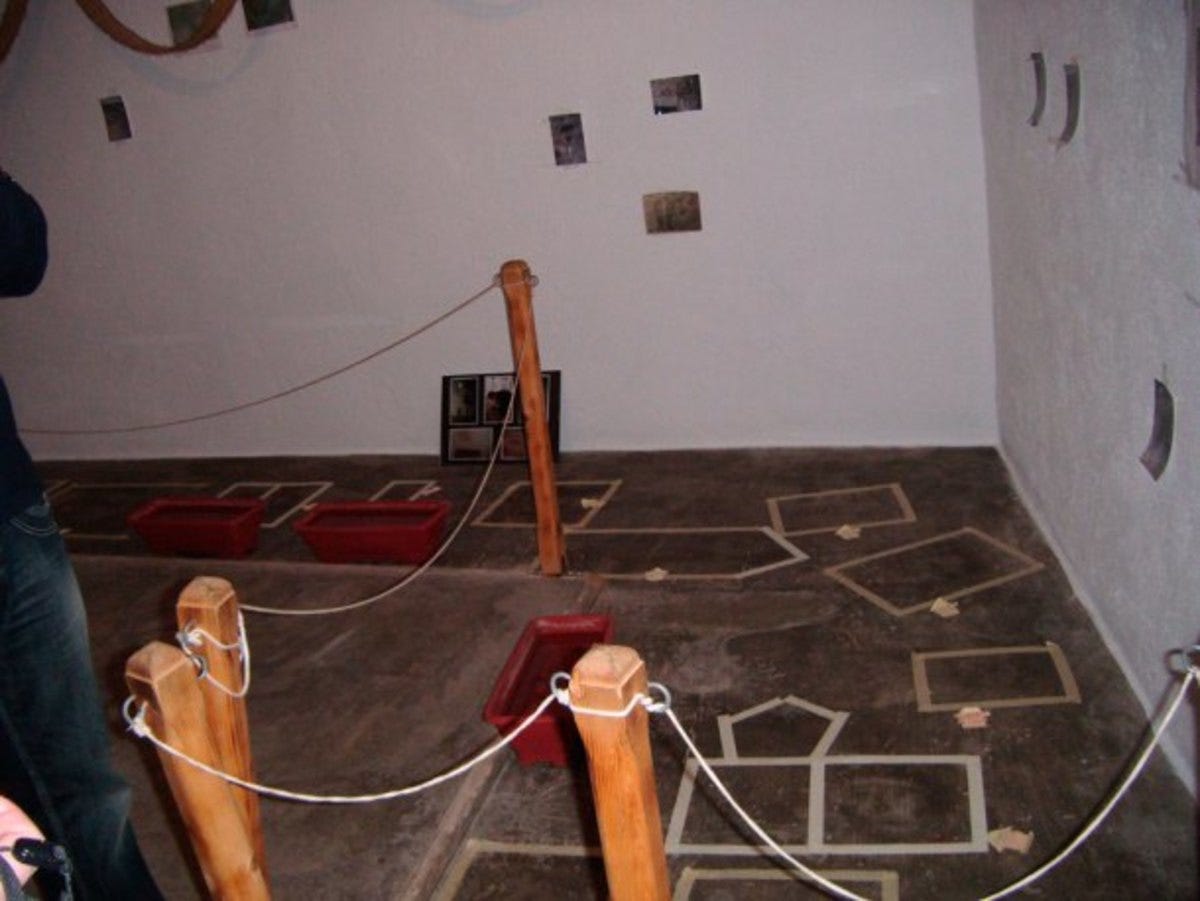
The floor, with each face distinguished by a tape border. Looks like the sort of art installation you’d pay too much to pretend to get.
Years of scientific research went into what might have been causing the faces to appear, but I’m less interested in their probable causes than the cultural phenomena surrounding them. Why did this story appeal to so many people?
As well as the Catholic culture the faces were part of, 1970s Spain was a turbulent place to be, to say the least. It was still under the rule of fascist General Franco in 1971 when the faces first started to appear. Although the dictatorship was nearing its end, and appears to have relaxed somewhat in comparison to its early days, living under fascist rule was no picnic. Under the dictatorship, Spain’s economy, culture and resources all suffered. It fell behind other Western countries and the Catholic church had a lot of power, especially over small communities (similarly to 20th century Ireland). I wonder if the psychological stress of growing up under this regime could have contributed in any way to the appearance of the faces. Did María or her family simply need a distraction? It’s not hard to see that the community of Bélmez as a microcosm for the bubbling resentment in the Spanish people, rising up and appearing as ghostly, wailing faces.

General Franco, not looking at all like an extra in Dad’s Army here…
Of course, there is a second explanation, other than a hoax – pareidolia. Pareidolia is the human tendency to see patterns, faces or other objects in places where there are none. It can be fun, creepy or even frightening. There’s even a reddit for it. Could these faces (or at least, some of them) have been nothing more than a trick of the eye?
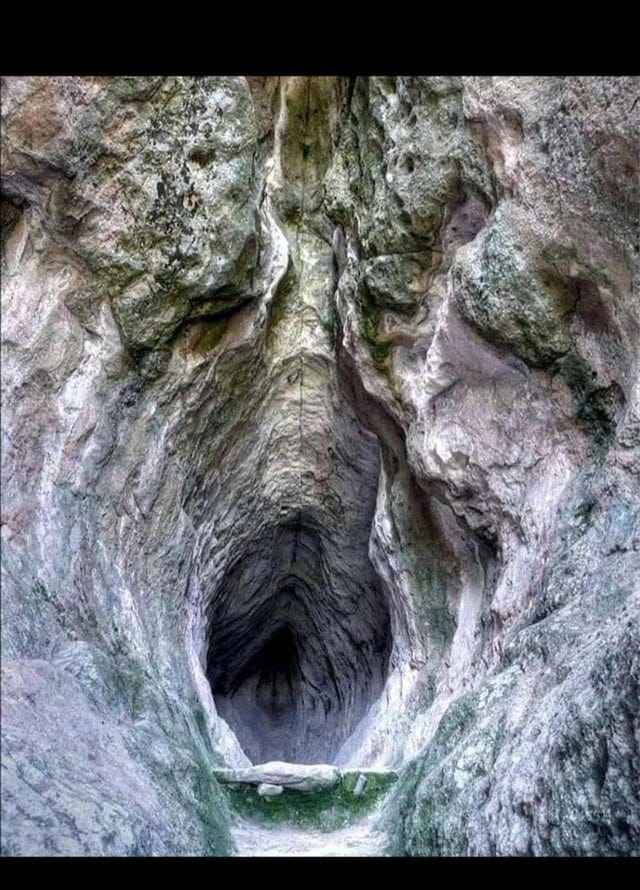
I don’t see it
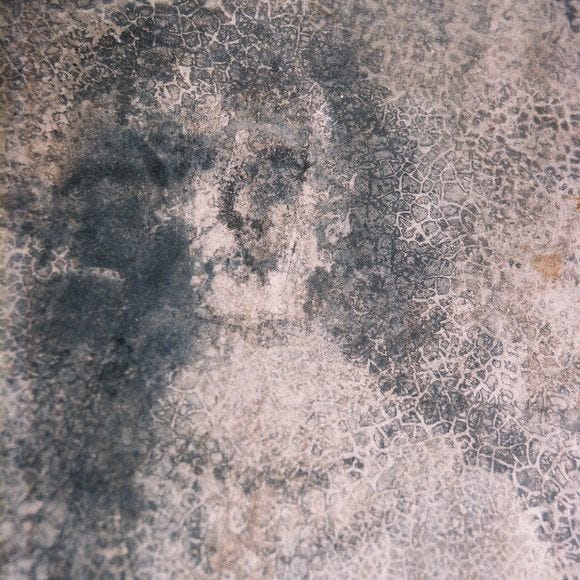
A floor face or a case of pareidolia?
A third explanation, and one that has been floated (heh) by several believers, is that María was responsible for the faces, but subconsciously. Through the power of thought alone, her mind was conjuring up the images, unbeknownst to her, as a reflection of her subconscious.
There are more questions I’d like an answer to – what about these skeletons?? Were they ever identified or dated? Where are they now? And what about these ghostly voice recordings? Can we hear them anywhere? And if not, why not?
This is definitely one of the stranger haunted house stories. Still not conclusively solved, it remains a bizarre quirk in 20th century Spanish history. And perhaps a reminder that a nice lino could’ve solved everything.
Next time: We’re back in Scotland with a haunted castle, the devil, secret rooms and monstrous children…
Enjoyed? Support me with the price of a coffee, or buy a ticket to Haunted House!
Eleanor’s Top Ten Hauntings of All Time | #6 Glamis: The Most Haunted Castle in the World
If there was ever a reason to abolish the aristocracy, this place is it
Jul 09, 2024
In honour of my Fringe Show Haunted House, I’m doing a top ten real life hauntings run down, and this time its one of Scotland’s most notorious castles. Glamis has EVERYTHING you could wish for in a haunting – a secret room, a pact with the devil, a hidden monster, a royal connection and a name everyone pronounces wrong. I don’t think I owned a single ghost book as a child that didn’t feature it. And yet I’ve never actually visited it, meaning that Glamis remains a phantom looming large in my imagination, still waiting to be explored…So without further ado…
First things first, Glamis is not pronounced ‘Glamis’, it’s pronounced Gla-mz or Glarh-mz depending on your accent, so if you’re planning a visit, get ahead of the tour guide and prove you read at least one thing before you went there. Let’s deal with the history before we get onto the ghosts.
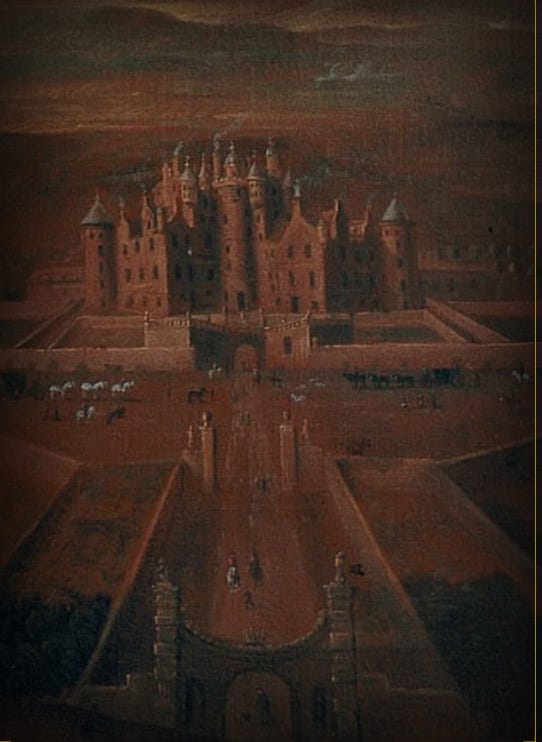
An early (and gloomy) look at Glamis Castle
Glamis haunts Scottish history. Not only has it been the seat of aristocrats and royals for hundreds of years, it was also the fictional place of residence for Shakespeare’s Macbeth. The real Macbeth had no connection, and to be honest, the locations in the play look like Shakey pulled them out of a scrabble bag at random. Most of them aren’t anywhere near each other. Still, I watched A Castle For Christmas on Netflix, and Brooke Shields takes a taxi from Edinburgh to Aberdeenshire, apparently, so he wouldn’t be the last writer to treat Scottish geography as a modern art project.
Glamis’ real royal connections are even more interesting than just The Scottish play. For starters, King Malcolm II was murdered there (on the site, at least) in 1032. The castle itself began construction in the 14th century, and the title of Lord of Glamis was created for Sir Patrick Lyon in 1445. The Lyons still live there – Queen Elizabeth’s mum, the late Queen Mother, was raised at Glamis after her father inherited it (I believe its the castle they visit in The Kings Speech), and is one of the many unbearable reasons King Charles likes to prance about in a kilt pretending to know anything about Scotland. Sorry – I find it hard to write about the royals. Ahem.
Glamis’ reputation as a place connected to misery and the supernatural began in 1537, when Janet Douglas, wife of Sir John Lyon, Lord Glamis was burnt at the stake at Edinburgh Castle, allegedly for attempting to poison the king (James V) and her own husband. Over the years, this poisoning attempt has morphed into an accusation of witchcraft – (there don’t seem to be any contemporary records mentioning the witchcraft), -probably because of the burning – and she’s now amongst the most famous ‘witches’ in British history.
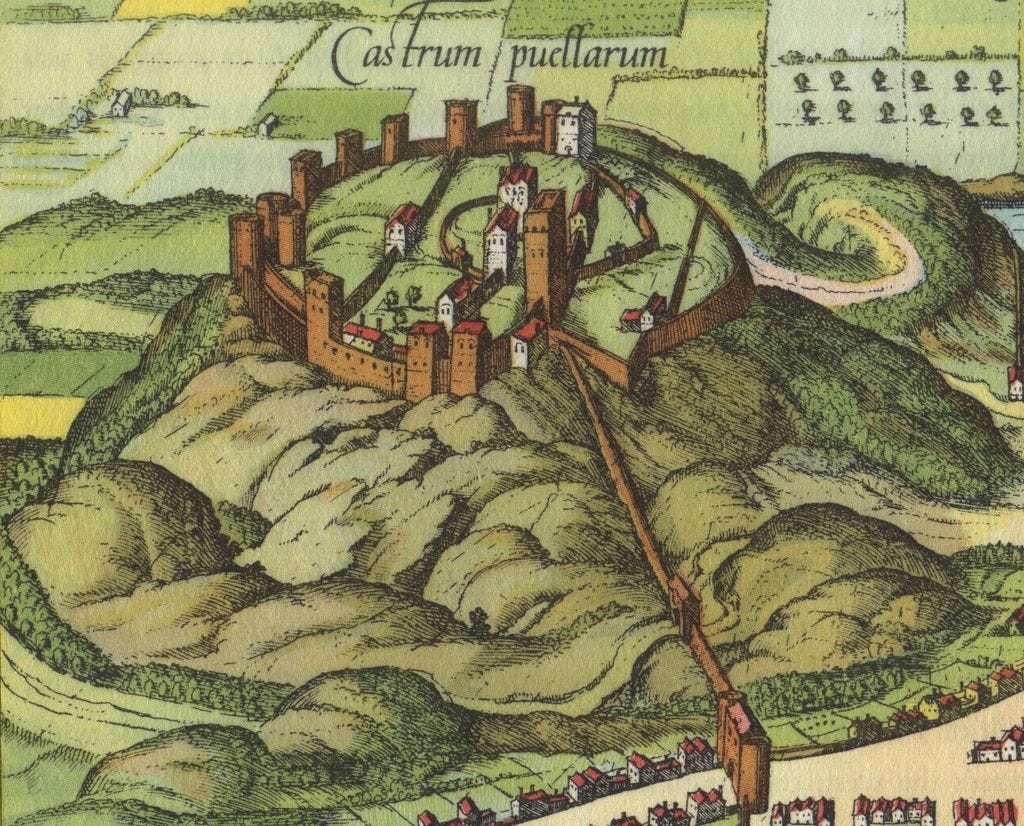
Edinburgh Castle, where Janet was burned to death.
After Janet’s burning, James seized the castle for himself, and it wasn’t given back to the Lyon family until 1543. Mary, Queen of Scots visited in 1562 to reconnect with the family after that awkward business with her dad burning their maw. There then began a series of redesigns and renovations, and over the next few centuries, the family kept their status intact by marrying into wealthy merchant dynasties, and generally doing rich people stuff. Over the years there were several more skirmishes, including the Jacobite rebellions, which the 5th Earl took part in on the rebel side. He was killed at the Battle of Sheriffmuir in 1715. The Queen Mother (Elizabeth Bowes-Lyon) was raised there, and her daughter, princess Margaret was also born there in 1930. The current owner, the Earl of Strathmore and Kinghorne, has his own ‘controversy’ section on Wikipedia, which includes speeding convictions, DUIs, Covid-19 violations and sexual assault. Classy.
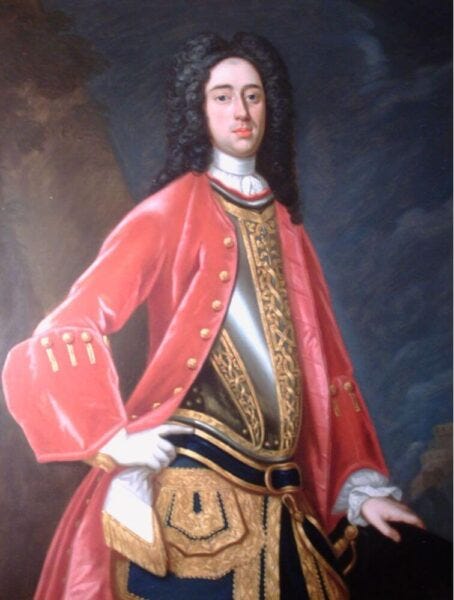
The Fifth Earl of Strathmore, a Jacobite and a snappy dresser
As might be expected from centuries of aristocratic shenanigans, the house holds not only your typical ghosts, but a whole array of oddities and spooks. Earliest amongst these is probably Lady Janet herself, now back as a traditional White Lady. There’s also:
A Grey Lady (Who may also be Janet)
A black page boy (who froze to death, and now likes to trip unsuspecting visitors)
A woman without a tongue who wanders the grounds, either pointing to her mouth or screaming.
Earl ‘Beardie’ – the ghost of an Earl who challenged the Devil to a game of dice on a Sunday, and is now doomed to play forever in a room high up in the castle, his cursing and dice throwing echoing around the house.
According to several reports from visitors in the 19th century, Beardie sometimes appears to visitors in their dreams, huge and imposing, and with ‘the face of a dead man’.
The first of the ‘horrors’ of Glamis is the supposed slaughter of Clan Ogilvie in the 15th century. In 1486, the Ogilvie’s were hiding from Clan Lindsay during a particularly nasty skirmish, and Lord Glamis agreed to hide them in the castle. But unfortunately for the Ogilvie’s, Glamis hated them too, and instead of protecting them, locked them in a secret chamber to die. (People like to romanticise clan warfare, but in reality a lot of wars were petty and bitchy squabbling over land and titles). Their skeletons were only uncovered years later, much to the horror of the finder, and their moans still haunt the house. I’ve yet to find any actual dates or sources for this supposed uncovering (nothing on the Ogilvie Wiki page, which you’d think would have a field day with this stuff), which leads me to think this is definitely a myth.
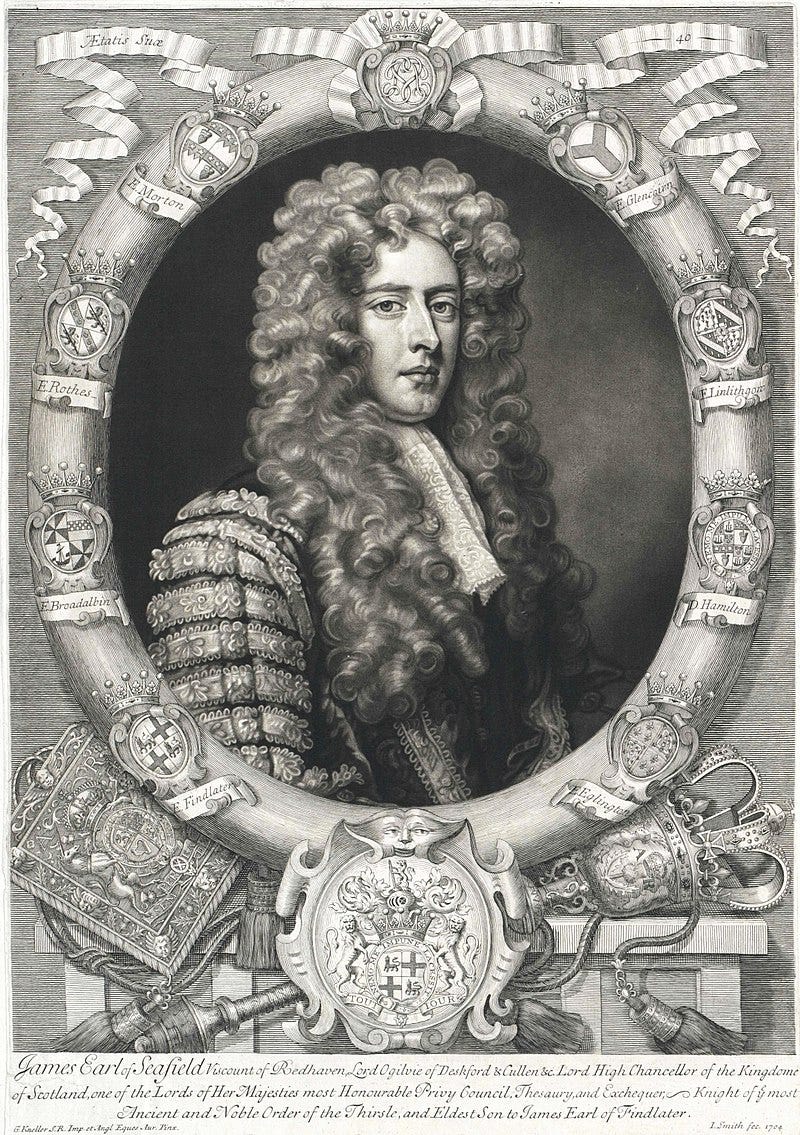
One of the later Lord Ogilvies, depicted here not starving to death in a secret chamber
But perhaps the creepiest and most fascinating tale is that of the Monster of Glamis – he’s so famous, he’s even got his own Wikipedia page! The legend is rather blurry, but it goes as follows:
In 1821, a baby was born to the Glamis family, Thomas Lyon-Bowes. Sadly, the baby did not survive, passing away the same day. However, a legend has arisen that Thomas did not die, but rather was born so deformed that his family decided it would be better to hide him away from the world. For the rest of his life (some say he lived 100 years) he lived in a secret chamber, which was then bricked up after his death. There is a ‘Mad Earl’s Walk’ along the castle parapet, supposedly where the ‘monster’ was taken for secret nightly exercise. Guests to the castle could occasionally hear his wails and cries in the middle of the night.
A story recorded by famed ghost enthusiast Colin Wilson recounts a workman accidentally coming across the room in the late 19th century, and immediately being pressured to emigrate with his family to Australia or another colony, never to tell his secret. Others who discovered the ‘secret of Glamis’ were reported to be so horrified they refused to ever spend another night in the castle…the 13th Earl was said to be so traumatised by the knowledge of the ‘secret’ that he forever looked sad, and was quoted as saying to his wife “I have heard the secret, and if you wish to please me you will never mention the subject again.”
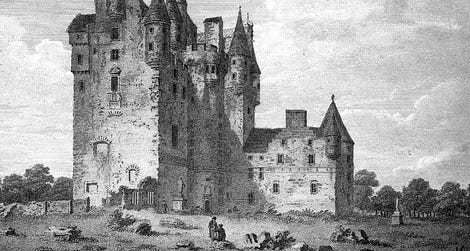
Glamis, full of secret rooms and skeletons? Or drunk aristocrats trying to entertain each other?
And yet, according to Scottish author Lily Seafield, the monster is also rumoured to have been born hundreds of years before, and legend of a secret room was also popular long before Thomas’ birth (Walter Scott, he of very boring tartan trash novels, mentioned it in 1790). There is even supposed to be a 17th portrait of the 3rd Earl that depicts the monster ‘lurking’ in the background, although I couldn’t find a portrait that resembles this. So was the ‘monster’ a disabled Victorian child, or some sort of ageless, supernatural demon, locked away for centuries?
Curiously, one guest, Lord Ernest Hamilton, found a trapdoor to the monster’s secret room in the Blue Room, which is also the room where visitors had their dreams of Earl Beardie, supposedly a huge and monstrous man…did two legends become conflated?
And yet there is more to this myth than meets the eye. A story that has clearly intrigued people over centuries, this tale centres on the idea of a human who is considered not quite human enough, a ‘monster’ who must be hidden from the world. And sadly, the legend would also be an eerie foreshadowing of a tragic chapter in the Bowes-Lyon family.
Nerissa Bowes-Lyon (1919-1986) and Katherine Bowes-Lyon (1926-2014) were two first cousins of the late queen, daughters of her uncle, John Herbert Bowes-Lyon. The girls were classified as ‘imbeciles’ and lived in hospitals for most of their lives. In Burke’s Peerage (a sort of posh people directory), there were listed as having died in 1940s and 60s respectively. It was only in the 80s that a tabloid exposé revealed they were both still alive. The family defended this by claiming that Fenella Bowes Lyon had made a mistake in her Burke’s listing. This is possible, but rather hard to believe – Fenella was their mother. Would she really, regardless of her own eccentricity, twice make a mistake about whether her own daughters were alive?
They were not the only ones – several cousins on their mothers side were also in the same hospital, suggested it was the maternal line responsible. (Given that the family name is Hepburn-Stuart-Forbes-Trefusis, this makes a lot of sense. After four double barrels, you can only assume their was some serious genetic tomfoolery occurring)
The girls were given little money and were never visited (the family dispute this, but there are no hospital records saying otherwise), given Christmas or birthday cards, or acknowledged in any way publicly by the family. Despite outwardly supporting disability charities, the queen mother never seemed to display the smallest interest in her nieces. Only after her death was revealed to the public did Nerissa receive a headstone. Before then, the grave only had a plastic marker.
The Royals were not the only family to shun and stigmatise disabled people in the 20th century, but what makes this remarkable is the amount of time they spent scoffing that the idea there was a disabled ‘monster’ hidden in Glamis was ludicrous, all the while hiding their own relatives away for the very same reasons.
Perhaps the ghosts of Glamis can serve as reminder that its best not to keep skeletons in the family closet…literal or otherwise…
Next time: A Georgian spook becomes a London celeb…
Liked this? Support me on with the price of a coffee here
Eleanor’s Top Ten Hauntings of All Time | #7 The Cock Lane Ghost: Stop it, It’s Not Funny
If you think being a comedian on the internet is hard, try being a ghost in 18th century London
Jul 16, 2024
In honour of my Fringe Show Haunted House, I’m doing a top ten real life hauntings run down, and this week its the not-so-sexy tale of the Cock Lane Ghost – a scandalous affair involving tabloid exploits, Hogarth, and rude names.
My first recollection of reading about this case came once again from Colin Wilson’s True Ghost Stories, and as a ten year old it took me a bit of time to wrap my head around the rather EastEnders-esque plot. There are lots of characters, two Elizabeths, a couple of marriages, one of them fake, and a confusing amount of money changing hands, but I think its important to the ghostly aspect of the narrative to understand the background of the players. This article was very helpful in reminding me of the particulars. What happened is as follows;
Our story takes place in 18th century Cock Lane, London. The origin of the name Cock Lane is a bit hazy – either it was a place where poultry was traded in the middle ages OR it was the site of a lot of brothels. Either way, the name is appropriate.
In 1760, Richard Parsons, a parish clerk, of Cock Lane rented out one of his rooms to a William Kent of Norfolk. So far, so London. Kent (that’s the man not the place) of Norfolk (the place, not a guy) had been married to one Elizabeth Lynes, but she died in childbirth, the child itself passing away two months later. The Kents had lived in the village of Stoke Ferry, with Elizabeth’s sister Fanny (grow up), who had come help look after the baby (not an uncommon practise at the time.)
Soon after Elizabeth’s death, Fanny and William began a relationship, which is, yes, pretty yuck. It’s not even as if they had the excuse of rearing the baby together. Records don’t seem to state Fanny’s age, but we can assume she was fairly young, and the whole thing has a slightly grubby vibe. Kent did want to make an honest woman of Fanny though – but he was told that marrying his dead wife’s sister was verboten (as Elizabeth had borne him a child, a union with her sister was viewed as incest).
By 1759, Kent was now in London (the man, Kent the place is in Kent, ok I’ll stop) attempting to put the whole palaver behind him. Fanny, desperately in love, followed him there, and he (apparently against his better judgement) agreed to let her live with him as man and wife. To be fair to Kent, he was trying to do the right thing (or at least appearing to). Although the Georgians were more laissez faire about sex before marriage than the Victorians would be, any children he and Fanny had would have no rights as his children, and would likely be shamed by society for their illegitimate birth. Since there was no real way to remedy this, breaking up altogether seemed the wisest course of action, but the headstrong Fanny would not accept it.
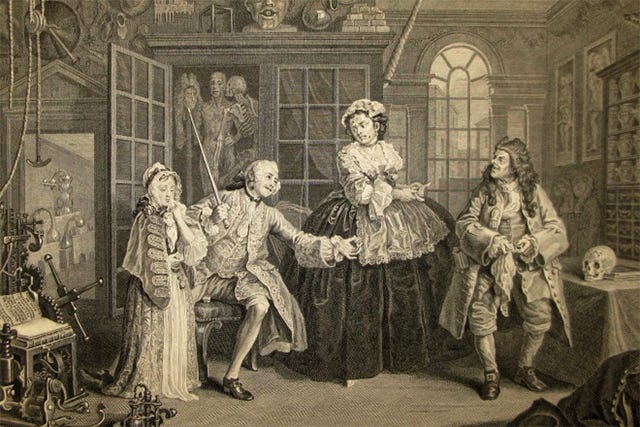
Georgian London – think less Bridgerton trysts and more syphilis, pre-marital hijinks and weeping sores.
Kent and Parsons met by chance at church one morning, and Parsons agreed to rent the young couple a room, no judgement. In fact, Parsons couldn’t really afford to be judgy – he was known as a bit of a drunk, always in need of money, and soon ‘Mr and Mrs Kent’ were lodging with the Parson family, which consisted of Richard, his wife and his two young daughters. The house in Cock Lane was a three storey building, with one room per floor, and a narrow stairway connecting them, fairly typical of older London streets of the time.
Kent then did Parsons a favour in return, lending him 12 guineas to be repaid one at a time. This is where the story always lost me as a child – if your landlord owed you money, wouldn’t you simply not pay them rent? Anyway, I digress. The scene is set. A respectable parish clerk always teetering at the edge of ruin, the scandalous Kents, and last but by no means least, Parsons’ 12 year old daughter, Elizabeth.
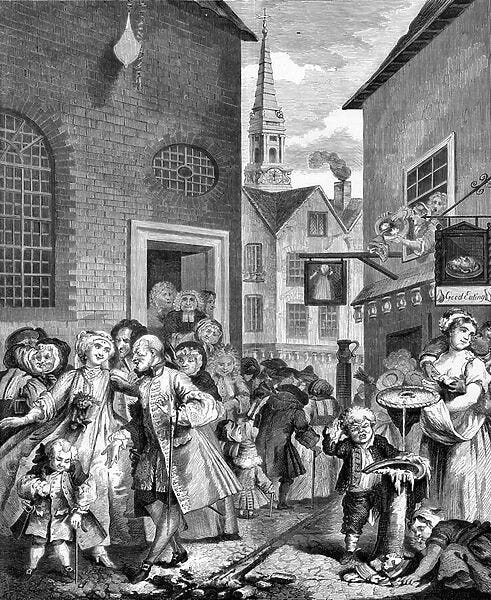
Another Hogarth Print – Four Times of Day, Noon, depicts Georgian London as a busy, bustling, noisy and crowded place to live.
The ‘Ghost’ first appeared whilst Kent was away. Fanny had asked Elizabeth, the daughter, to share her bed whilst Kent was away. This might seem a bit weird to us now, but separate beds and bedrooms are a more modern concept than we think. Servants would have usually slept in their masters rooms, on ‘truckle beds’ and Fanny, like many other women, may have wanted someone else present to dissuade any male night time visitors. Fanny was also pregnant, and probably needed someone keep an eye on her.
Elizbeth and Fanny began hearing scratching and rapping noises (a classic sign of an early poltergeist manifestation) which they could not account for. It didn’t seem to come from neighbouring shops (Cock Lane had lots of workshops and would have been very noisy) and one by one neighbours trooped in to listen to the noises. The first thing that most people think when they hear ‘scratching noises’ is rats – how could it be anything else? But assuming that Georgians would know exactly what a rat sounded like, we can take it for granted that these noises were different enough to freak out Fanny and her 12 year old charge.
The noises continued, and a neighbour and Parsons both claimed to see a figure in white in the house, with the cobbler seeing it on the stairs.

What appears to be a clergyman (probably Parsons) witnessing an apparition who seems to be glowing (and about 7 feet tall). The giant, Ikea-kitchen-style clock points to midnight
Once Kent returned, however, and Elizabeth went back to her own room, the noises apparently ceased. Not long after, in January 1760, the Kents moved out in order to prepare for the arrival of their baby, but Fanny fell ill and was diagnosed with smallpox, dying in February 1760. After her death, the Lynes family discovered that Fanny had left almost everything she owned to Kent. The Lynes were not happy, and started proceedings against Kent, who was already remarried by 1761.
All was quiet in the Parsons household (at least, in terms of ghosts) until 1762 when, just as Kent himself began proceedings against Parsons (who still owed him money) the scratching noises started up again. Another lodger moved out after being unable to stop them, and the wainscotting around Elizabeth’s bed was even removed to try and locate a source for the noise. Elizabeth, like most tweens in poltergeist tales, was acting up, and appeared to have fits as well as be a conjugate for the noises.
Once again, the mysterious noises began to attract attention – this time with a juicy caveat – could the original noises have been the ghost of Elizabeth Lynes (Fanny’s sister) warning Fanny that a life with Kent was doomed? And had Fanny herself now returned to tell the Parsons something about her untimely death?
More and more visitors flocked to the house. Seances were held, experiments done, and ‘Scratching Fanny’ became the talk of the tun. (They say that in Bridgerton, right? Am I doing it? Am I doing popular content?).
Of course, it won’t escape the modern reader (or any reader after the mid 19th century) that a ‘scratching Fanny in Cock Lane’ is quite the mental picture. Some people speculate that ‘Fanny’, the women’s name, took on its slang meaning (in UK English, a vulva) after the 1748 publication of Fanny Hill, about a sex worker’s exploits in London, but we can’t be sure people around the time of the ghost would have used it that way. Cock, on the other hand, definitely had its meaning firmly, ahem, rooted by that point. Either way, the talk of premarital sex, death and impropriety gave this story a seediness that delighted the British public, regardless of the names. Cock Lane was overrun with the coaches and horses of the great, the good, and everyone in between, all clamouring for an audience with Scratching Fanny Herself. Parsons began charging people to enter, claiming that he needed the money since he could no longer rent his rooms. Hmmmm.
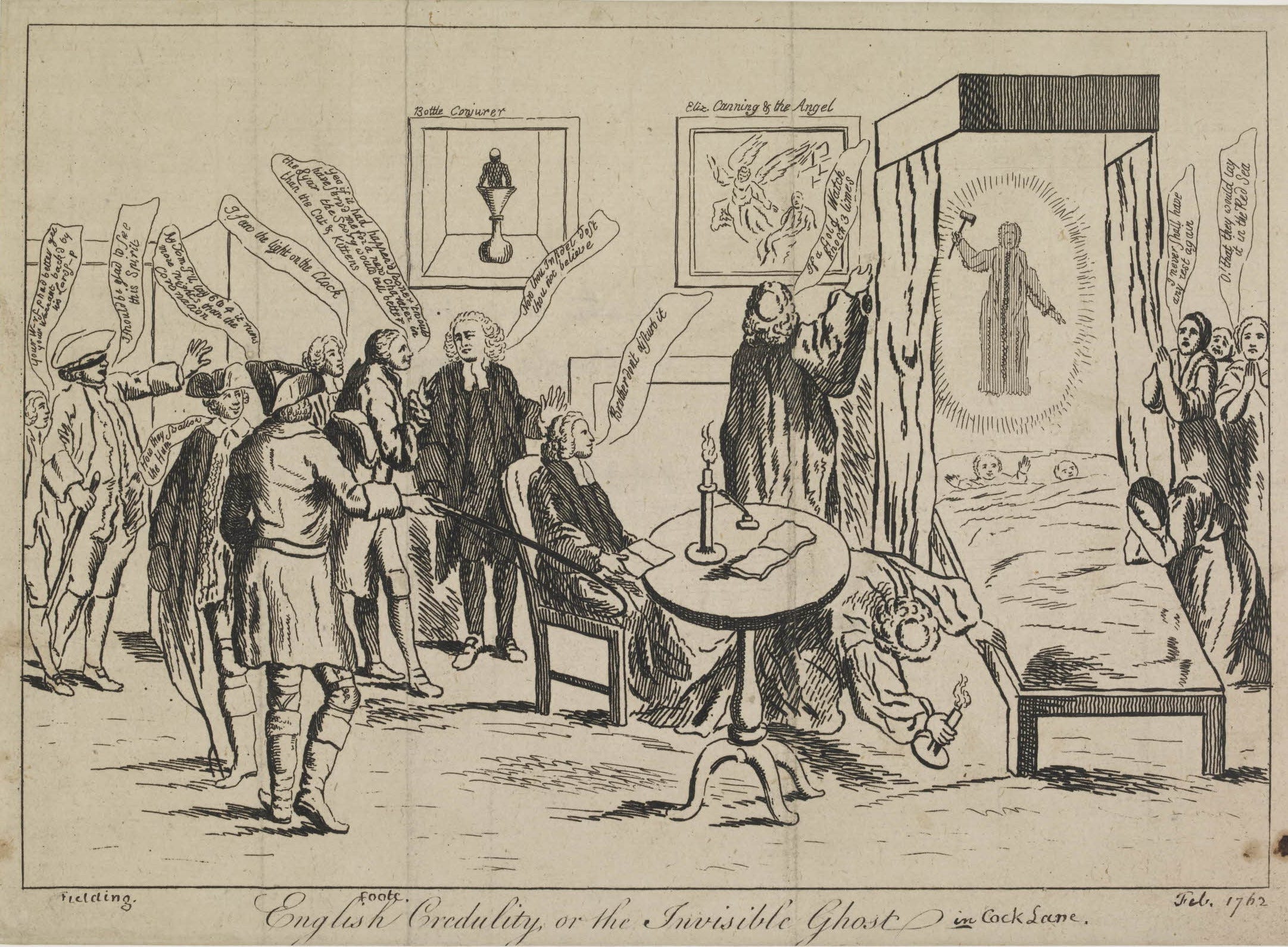
One of several depictions of the Cock Lane ghost at work – here men check under the bed, women pray, and the children (who appear to be babies here) are the centre of the phenomenon. On the wall are prints of two recent hoxes – the kidnap of Elizabeth Canning, and the Bottle conjuror, suggesting the artist doesn’t take this haunting too seriously.
Parsons approached assistant preacher John Moore at his church, St Sepulchre, for help. They devised a system which would be used in other ghostly encounters to come- one knock for yes, two for no. With this morse code in place, they asked the ghost to explain itself, and the ghost came out with an extraordinary tale…it claimed to be Fanny, telling them she had been murdered by Kent, who had given her arsenic mere hours before her death. All of this rapping, of course, took place within the presence of the young Elizabeth Parsons.
This scandalous revelation was huge, and Kent himself soon got wind of it. He demanded vindication, whilst Elizabeth Lynes sister Ann demanded to see her body, which would indicate her true cause of death.
Elizabeth Parsons was thoroughly (some would say too thoroughly) examined – undressed in front of a crowd, being strung up in a hammock, having her arms and legs held, and it was discovered the knocks would not manifest when she was held, or completely visible to spectators. She was also sent to stay in other houses, where the noises sometimes followed her, and sometimes stayed behind in Cock Lane. Eventually, after being threatened with Newgate prison if the knocks did not manifest, she was caught with a piece of wooden board in her bed, more or less confirming for sceptics that the whole thing was a hoax.
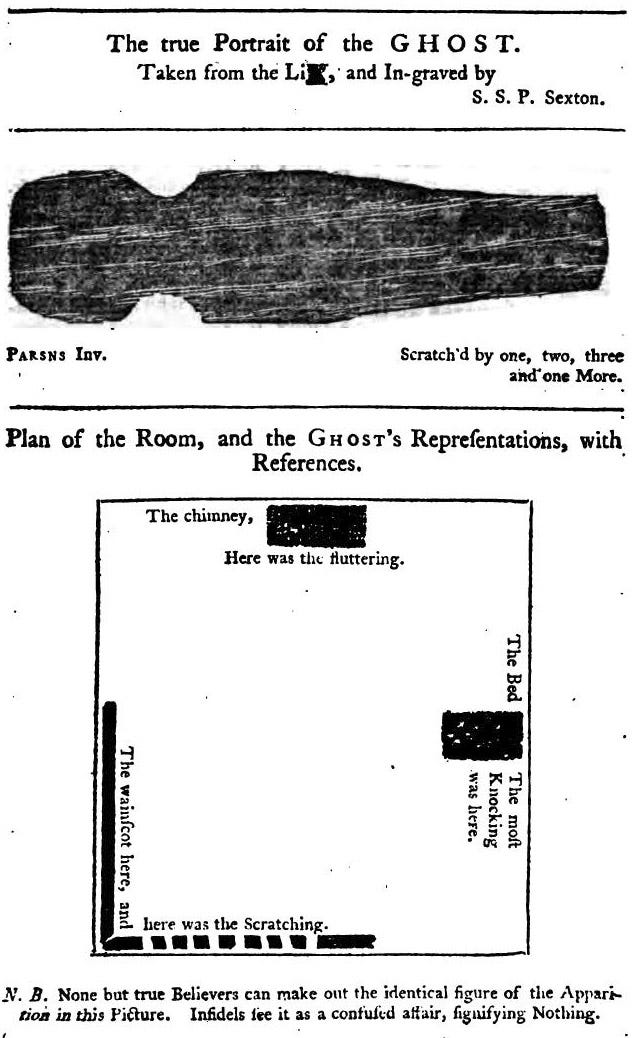
Ooooooooooo – It’s a bit of wood!
Meanwhile, Kent was insisting his innocence be proved once and for all. On 25th of February, 1762, Kent, the parish priest, sexton and several others, went down to the vault where Fanny was interred. With baited breath, they prised open her coffin lid, only to discover, to their horror…the corpse of a woman who had been dead for two years. Yup. Just a dead body. No signs of poisoning of foul play. Gross.
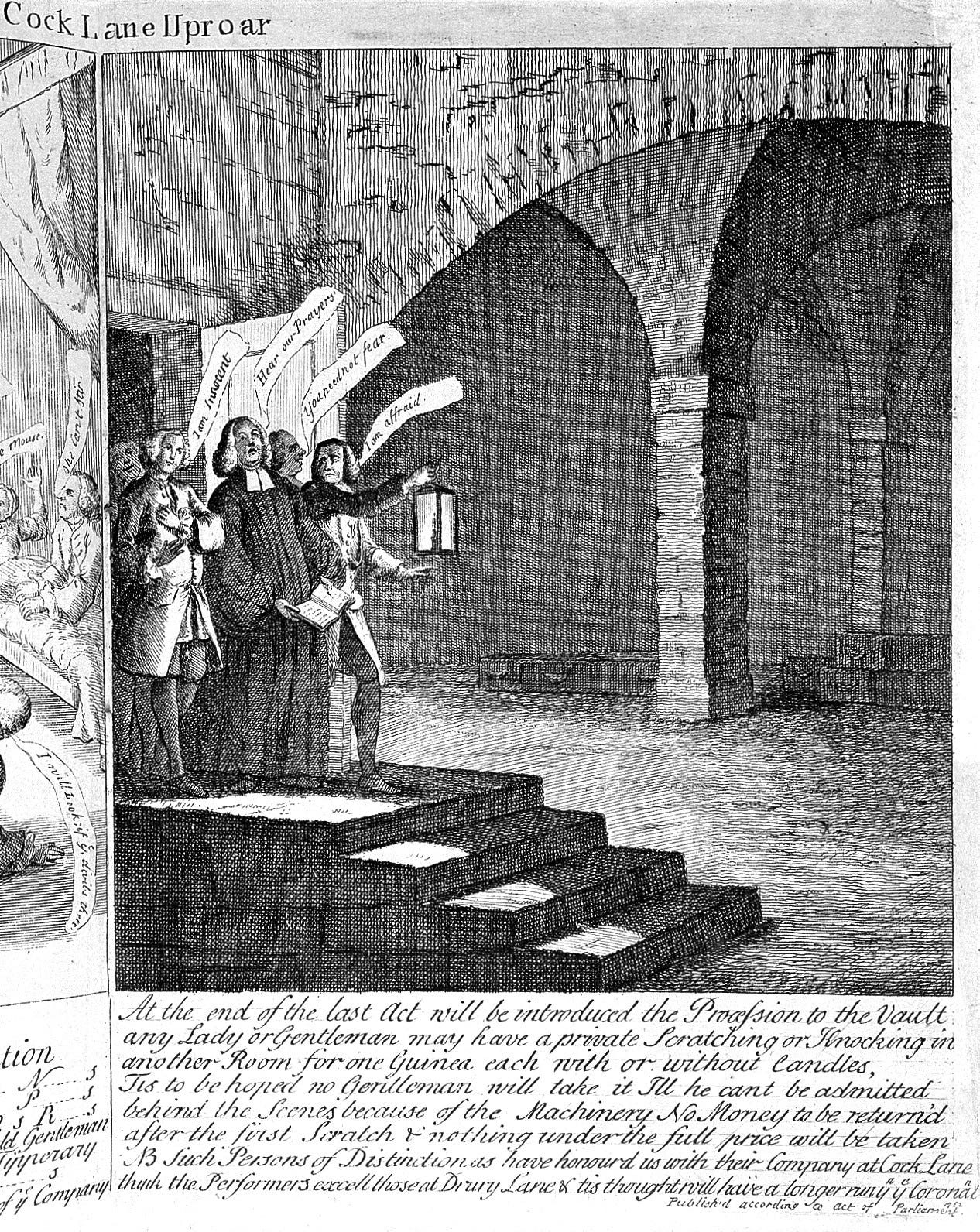
You know a prank has gotten out of hand when they’re digging someone up.
And so that was that. Well, almost. It turns out unfairly accusing someone of murder is slander, whether you’re a ghost or not, and so Parsons, his wife, John Moore and several others were all charged with conspiracy. Kent and his supporters proved that Fanny was ill with smallpox, not poison, and that the noises heard before she died were considered by many a hoax. John Moore, who seems to have been the most honest about his part, said that although he did not cause the noises, he had no idea who did and whether they were really supernatural. Most of the defence witnesses seemed really to believe that the noises were made by unseen forces. Parsons and the others were all found guilty and had to pay Kent several hundred pounds (lot of money in them days). Parsons was also sentenced to be pilloried (i.e. put in the stocks, which, unlike in American fantasy movies where people throw tomatoes and other New Word veg, was actually a horrible and highly dangerous experience. Dying in the stocks from abuse or injury was not uncommon). Luckily for Parsons, the community took his side, and he was protected from abuse by neighbours.
The Cock Lane ghost is perhaps the least ghostly of all the haunted houses featured. Actual apparitions were sparse, the hoax seems pretty obvious, and a majority of the people following the case at the time did not seem to take it seriously.
Yet it remains fascinating for several reasons. Firstly, as an incredibly well documented example of a haunted house. Few cases in history have so many witnesses, documents and testimonies to their name. And it also carries the glamour of celeb – some of the witnesses and interested parties included figures like Horace Walpole, Samuel Johnson, the Duke of York, and of course, William Hogarth, who created numerous etchings about the case.
Cock Lane serves as a perfect showcase of many Georgian fears, interests and beliefs: Methodism vs Anglicanism, celebrity writing and publishing, science vs superstition, and an obsession with weird and wonderful ‘true’ stories, such as Mary Toft, the woman who claimed to give birth to rabbits. Just as today, Georgians were constantly clamouring for the next big story, and many people were eager to get their 15 minutes of fame.
Perhaps most notably, it was used as an example by satirists like Hogarth of the ways in which the British public were not the enlightened thinkers they considered themselves to be. At the height of the Age of Reason, the fact that thousands could have been fooled by a 12 year old girl and a bit of wood must have been an embarrassing stain on the British psyche.
There are also uncomfortable messages here about the treatment of girls in Georgian society. Elizabeth Parsons, barely a teen during the case, was prodded poked, violated, deprived of sleep and abused in many other ways by adult men in this case, and no one seems to have commented on the inappropriateness of this. Like in the later case of The Salem Witch Trials, female children were at once taken seriously in their cries of ghost, and at the same time dismissed as mere objects without agency. Was it all Elizabeth’s fault? Or the fault of the many, many esteemed adults who took her seriously, and the father who potentially exploited her?
Lastly, I think the Cock Lane ghost and its seedy undertones remind us what humans really care about: money, sex and status. The noises did not really ramp up until Kent went after Parsons for the substantial amount of money he owed, and I think this says a lot about the true priorities of the so-called Cock Lane Ghost.
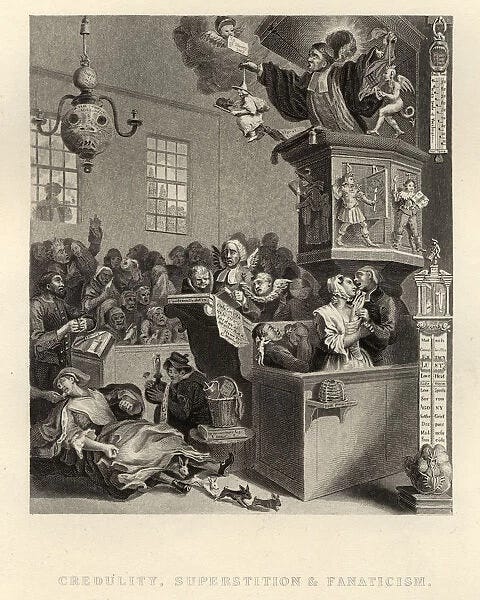
One of the most famous artworks depicting the ghost, by Hogarth: the Cock Lane Ghost can be seen at the top of the thermometer on the right, which apparently measures types of human madness. Mary Toft is on the floor, pushing out bunnies.
Next time: A Haunting at a Jamaican Plantation may be myth, but reveals some very real horrors…
Liked this? Support me on with the price of a coffee here or buy a ticket to Haunted House!
Eleanor’s Top Ten Hauntings of All Time | #8 Rose Hall, and the ghost that never was
A fictional ghost is a spectral smokescreen for Jamaican history’s real horrors.
Jul 23, 2024
CW: Sexual assault, violence against enslaved people, slavery.
In honour of my Fringe Show Haunted House, I’m doing a top ten real life hauntings run down, and this time we’re in the Caribbean for a ghostly story that’s not what it seems…
The White Witch of Rose Hall is a story that popped up in several of my ghost books as a child, yet the facts always seemed tantalisingly scarce. It’s a melodramatic tale of magic, murder and one woman’s evil passions, all set in the heat of the tropical Jamaican countryside.
Inevitably, Jamaica’s bloody and dramatic history has been the basis of many ghostly legends over the years, and the story of Annie Palmer, the so called ‘White Witch’ (literally) of Rose Hall, is perhaps one of the most well known. The hall’s global reputation as one of ‘the most haunted places is the world’ has been cemented over time by reports and sightings of the ghost of Annie, wandering the grounds, and plenty of paranormal tv shows have ‘investigated’ the haunting for a viewing audience. The story is as follows:
Annie Palmer, a white woman from Haiti, married plantation owner John Palmer, the owner of Rose Hall, near Montego Bay, Jamaica, at some point in the late 18th century. Annie, an orphan, had been raised by a voodoo practitioner and was herself skilled in the arts of magic.
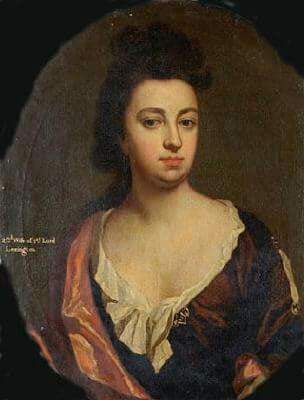
An image often used to represent Annie Palmer, although the picture looks to be late 17th century, and therefore too early to be Annie.
Annie was a beauty with lustrous hair and brown eyes; unfortunately, she was also a violent and unstable woman with a lust for power, and the men under her control. After her husband caught her in the act with one of the slaves, she had him murdered, either by her own hand or on her instruction. Soon she began to take many slaves as lovers, and the men, powerless to reject her, were subjected to her assaults regularly. She would then murder the men when she tired of them. Her reign of terror over Rose Hall was infamous all over Jamaica, and cemented her reputation as a truly evil figure amongst the white gentry, earning her the nickname ‘White Witch of Rose Hall’. She married twice more, but each time her husband would end up dead, buried somewhere anonymous on the planation.
Inevitably, Annie’s violent and lustful ways would be her undoing. Jealous of a would-be lover’s girlfriend, the daughter of Takoo, a powerful magician, she had the girl murdered. Takoo then murdered Annie, either by force, by magic, or both, and the White Witch of Rose Hall’s dictatorship was brought to an end.
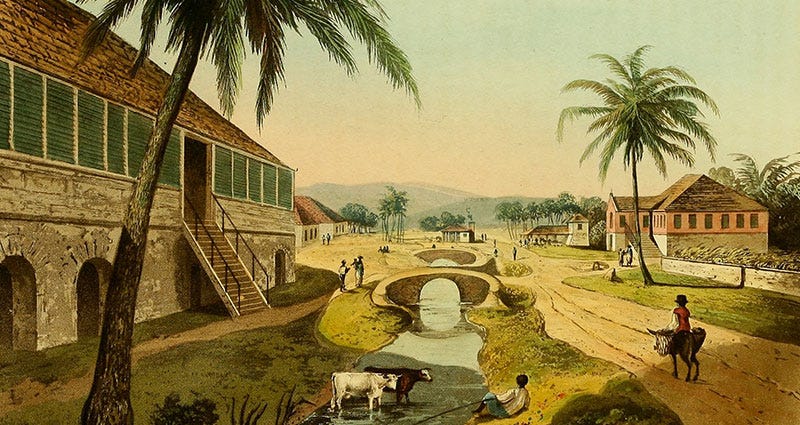
A Jamaican Plantation, possibly Rose Hall, from the period of the legend
But the ghost of Annie Palmer did not rest easy…cursed to roam the grounds, her spirit has been seen often in Rose Hall, and visitors report feeling an uneasy presence watching them from the shadows, or see her, standing on the balcony or riding in the grounds…it is said that the early deaths of subsequent owners of Rose Hall were due to Annie’s curse.
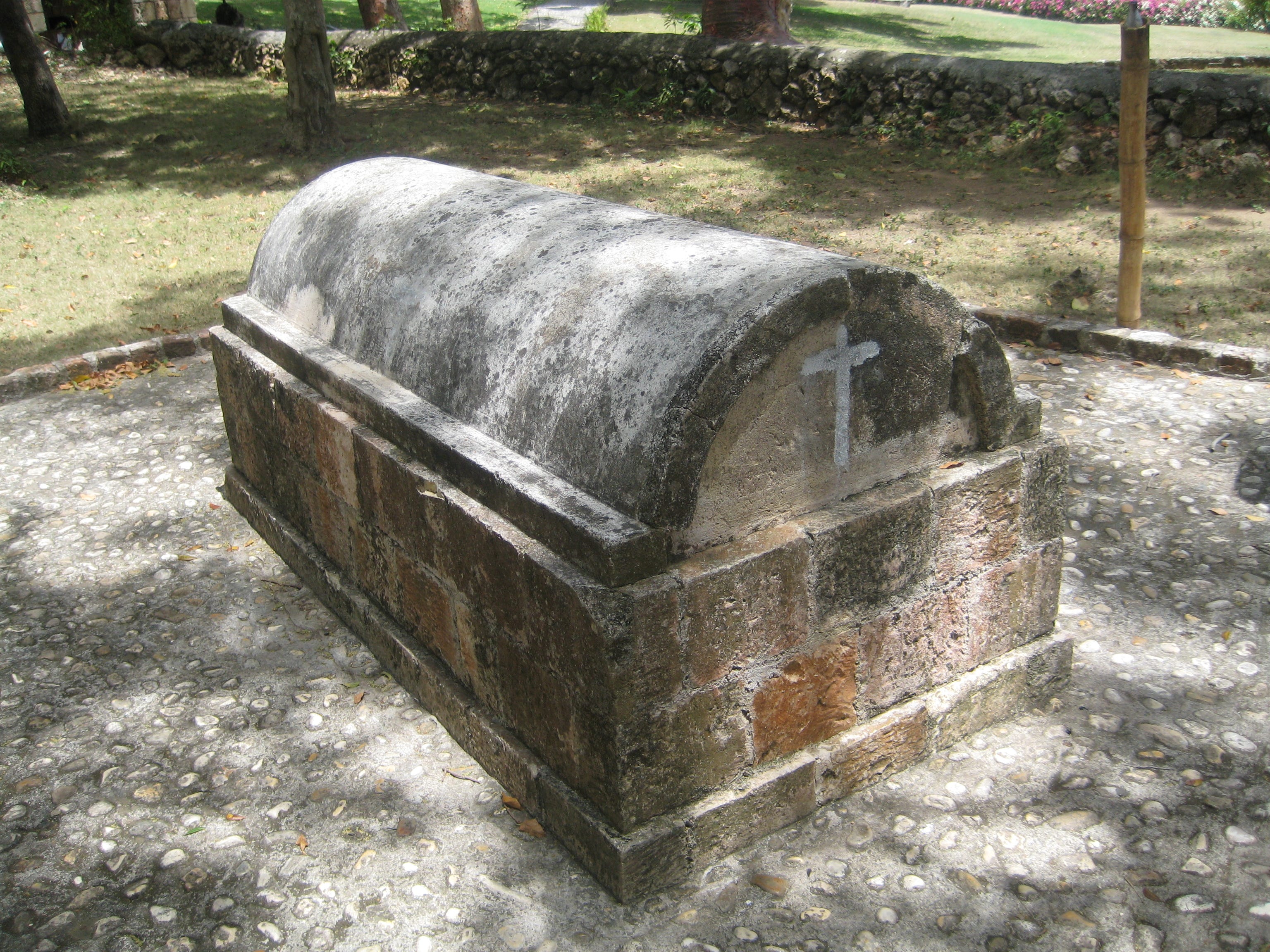
Annie’s tomb…? (No)
What a story! It’s got everything; sex, death, magic, a femme fatale and a vengeful magician. But as you might have noticed, there aren’t a lot of solid facts here. Things like dates, names, records and first hand accounts are conspicuously absent. No paintings or portraits of Annie which match the stories alleged dates exist, and the tale itself can’t seem to be traced back before the 20th century.
So what’s the real story? Rose Hall is definitely a real place, and a popular tourist destination. You can even get married there…if you really want to. As well as being a big draw with visitors, the legend has become the basis of several songs, novels and even an episode of America’s Next Top Model (This is VERY on brand for ANTM, they pulled some pretty atrocious and very mid-2000s stunts during its run)
In 2005, paranormal investigator Benjamin Radford decided to do some digging and uncover the truth behind Rose Hall’s most infamous tenant. As he details in this article, much of the legend can be traced back to a 1929 novel by Herbert G. de Lisser, The White Witch of Rose Hall. There is, in fact, no historical figure whose life, dates or death can be matched up to the tale.
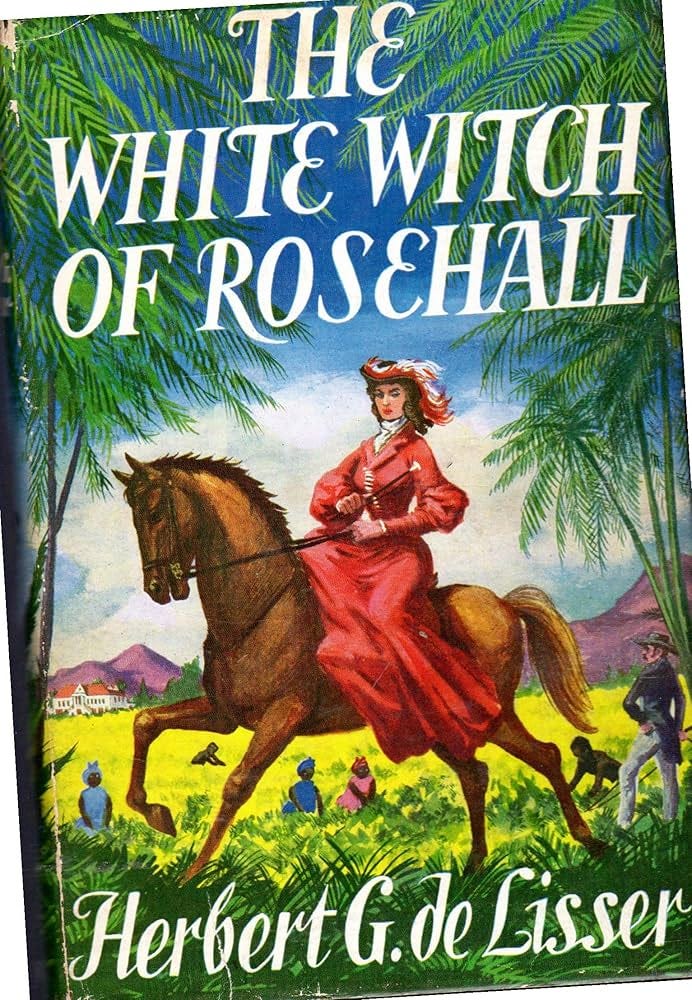
A very romantic depiction of Annie, for Herbert Lisser’s novel
Radford, try as he might, uncovered absolutely no evidence that there was every an Annie Palmer at Rose Hall. The editors at Wikipedia, apparently keen to find some sort of real world connection, note that there was a real Annie Palmer in Jamaica, as well as a Rosa Palmer of Rose Hall (d. 1777), who actually did have multiple husbands (none of whom died mysteriously)
So there we have it, the ghost of the evil Annie Palmer laid to rest. Except…
If you’ve read any of the other articles in this series, you’ll know that historical context is my main fascination with these ghost stories. And the historical context for the Rose Hall legend is particularly rich. The reason I find Rose Hall such a compelling story is not so much the ghosts as the underlying implications that the story holds about Jamaica and its past.
Firstly, it’s a story set in slavery era Jamaica, already an environment ripe for horror. It’s the story of a power struggle between the white land owners and the enslaved. And its a story that plays on fears around female sexuality.
The story of Annie Palmer is frightening for several reasons, and for several different demographics of readers. For a black Jamaican audience, tales of cruel overseers and slave owners were very much a reality for their ancestors, and Annie Palmer embodies the very worst of them. Not only is she abusive and murderous, she has magical power that can only be defeated by a similarly talented magician. For white audiences, reading in the early 20th century, it’s a tale than personifies white fears about race relations and power dynamics – the horrors of retribution and revenge made demonic.
As Shalman Scott notes in this Jamaica Observer article discusses, Rose Hall and its grisly legend has overtaken many more important (and, crucially, factual) slave rebellions and uprisings from Jamaican history, such as the Sam Sharpe rebellion. This colonial narrative was upheld for a long time by the British Empire and its influence on the Jamaican education system, which sought to omit or distort much of the history to create a timeline better suited to white historians. The fact that the entirely fictional Annie Palmer is more famous that many black historical figures is not really that surprising.
Further, I think the story tells us a lot about the psyche of slave owners and their descendants, and their fears surrounding slavery. Annie Palmer’s sexual aggression and abuse, her use of slaves to satisfy her own desires, discarding or murdering them once she was bored mirrors the very real records of white male slave owners, who, its well documented, systematically raped their enslaved female workers, very often siring children with them who would then be used as enforced labour on their father’s plantations. The Annie Palmer legend twists this truth and asks what might happen if the genders were reversed, and white women had the chance to abuse black men in the way black women were abused by white owners (I’m sure female on male rape occurred too, but it was not a systematic tool of power. Hey wasn’t this supposed to be a fun article about ghosts???) It’s a hypocritical tale that paints a woman in the role of sexual deviant and abusive master, because women who weaponise their sexuality are much scarier to a male audience than a man would be. If we decided to create a ghost story about a male slave owner who raped and brutalised his female workers, the historical sources would be too numerous to count. Annie scared white male readers in the early 20th century because she is, to them, an anomaly: a woman with power, and black readers because she embodies the very real historical violence that their ancestors endured, and which continues to have ramifications today.
Further, the underlying themes of Voodoo remind the reader of the ways in which the enslaved were able to control their own narrative and take back power, by using systems of belief that the coloniser had not managed to control. Annie’s Voodoo magic can only be defeated by a black magician of similar strength.
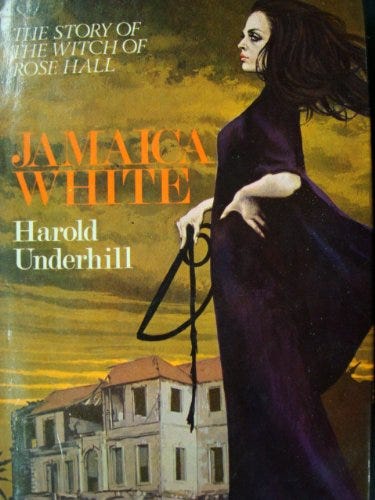
A slightly pulpier, more gothic and sexed-up depiction of Annie.
Finally, I think it would be remiss of me not to discuss the Rose Hall legend and its connection, like so much of Caribbean history, to my own country. The real Annie Palmer, nee Paterson, (who did not have a connection to Rose Hall but was a Jamaican of the same time period) was of Scottish descent, and in writing about the legend I am reminded that Scotland’s part in the slave trade is often overlooked or buried by Scots who would rather not admit that we were very complicit in it.
Growing up with a love of etymology and Scottish history, I always thought it interesting that so many Caribbean British celebs – Naomi Campbell, Moira Stewart, Trevor McDonald – had Scottish surnames, and it wasn’t until I was a teenager that I made the connection. Not only were Scots involved in the transportation of people from Africa, they also greatly benefitted from owning plantations in Jamaica, Barbados and other Caribbean islands.
I’ve always been proud of Scotland’s relatively outward looking and welcoming reputation, and our underdog status, but somewhere along the way to painting ourselves as plucky and courageous, we have managed to bury the fact that we had a lot of money and power in the Empire. Scotland was not a victim of the Empire, but a benefactor. You didn’t even have to be rich to benefit – records show that many middle-class Scots owned one or two slaves overseas and received an income from it.
Overall, the haunting of Rose Hall has reminded me that I would absolutely love to go to the Caribbean, and if I wapped on enough factor 50 and got a big sunhat, I think I’d have a great time. The history of Jamaica is rich and at times very dark, and it would be incredible to see it first hand.
So, perhaps what Rose Hall really does, as a ghost story, is to remind us that, as creepy as ghosts can be, nothing is more truly horrifying that the legacy of slavery, and its continuing effects today.
Thank you for making it this far in such a heavy episode of this series! I think its really important to explore these things when it comes to myths and legends. We’ll be on spookier, sillier ground in number 9…
Next time: A Welsh couple find themselves haunted by a tech loving spirit…
Liked this? Support me on with the price of a coffee here or buy a ticket to Haunted House here!
Eleanor’s Top Ten Hauntings of All Time | #9 The Cottage Computer Ghost
What’s scarier? Ghosts or technology?
Jul 30, 2024
In honour of my Fringe Show Haunted House, I’m doing a top ten real life hauntings run down, and for number 9 we’re on the English/Welsh border for a lesser-known tale of spooks, computers and creepy cottages…
I remember reading about this case briefly in one of my many ghost books of childhood, but it wasn’t until I heard an episode of the brilliant Dark Histories podcast which covered the whole thing in detail that I learned the whole fascinating story. Other sources today include How Stuff Works, North Wales Live and Historic Mysteries. What marks it out as one an important tale in the history of the haunted house is its dubious honour of being one of the first recorded cases of haunting to involve communication through computer technology.
Our tale takes place in the Village of Dodleston, which lies in Cheshire, on the English/Welsh border. Recorded as a settlement in the Domesday book of 1086, like many English villages it boasts castle ruins, a picturesque church, and a couple of famous sons, including an Elizabethan noblemen involved in court politics, Thomas Egerton, and the father of Everest-climber, Canon Herbert Leigh-Mallory. Currently, it has less than 1,000 residents.
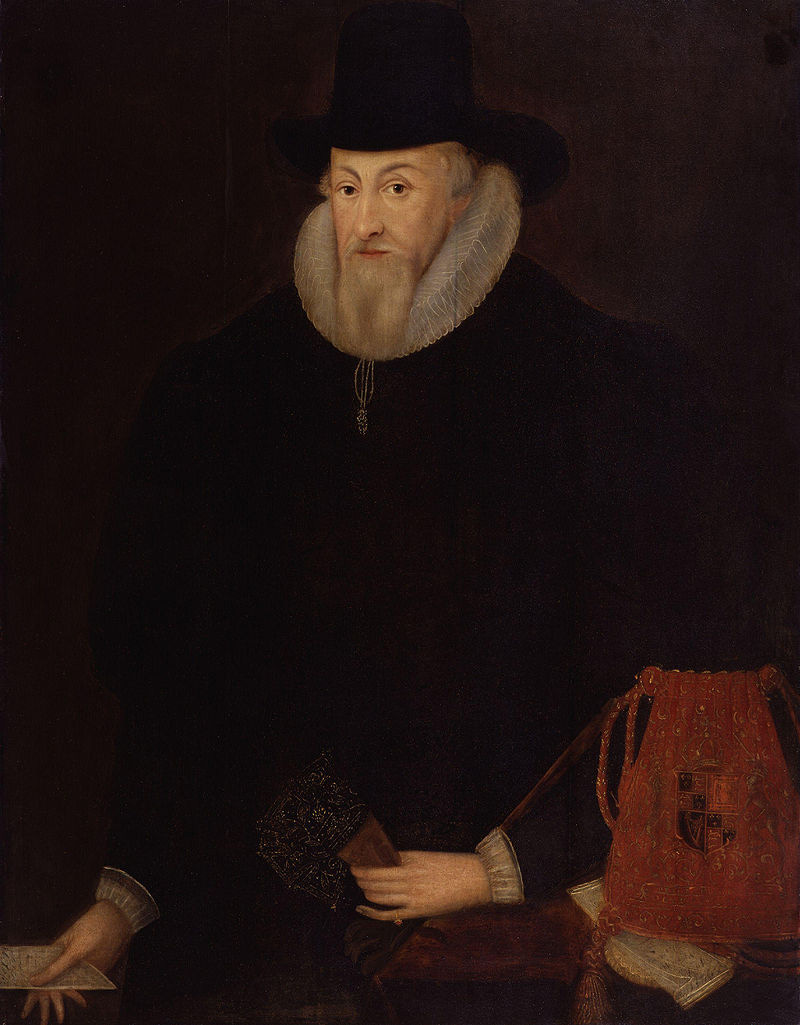
Thomas Egerton, with his school backpack
In 1984, local teacher Ken Webster and his girlfriend Debbie were living in an 18th century brick cottage in Dodleston known as Meadow cottage. Ken taught economics at the local high school, over the border in Wales, and he and Debbie were in the process of fixing up the cottage, which had become dilapidated over the decades. Ken also had in his possession a very early version of a home computer, a BBC Micro, introduced by the BBC to encourage literacy programmes. He borrowed it each weekend from the high school, and he, Debbie and Nick their lodger* would take it turns to use the computer’s word processor, EdWord.
*In some versions Nick seems to be Nicola, which I assume means its a pseudonym, I’ll keep calling whoever it is Nick for the sake of consistency
As a child of the 90s/early 2000s, I have only vague memories of these chunky word processor style computers. I still remember the dial-up tone and the very early versions of interactive games on early home computers; my dad had some sort of tool game where you clicked on different tools in a garage and they would move or make a noise. Unbelievably, this was incredibly entertaining back in the day. My siblings and I would spent ages clicking on the hammer so it would make a ‘bonk’ noise. Happy days.

A BBC Micro from the 80s, a thicc piece of technology that would’ve taken up a whole desk (Source: North Wales Live)
Ken’s computer was even more primitive – it had only 160kb of data (modern smartphones have around 128 GB) and needed external hard drives. But to the residence of Meadow Cottage, it was an impressive piece of tech.
The first signs of paranormal activity, however, did not come from the computer. They came, rather more creepily, in the form of footprints that appeared to go up the walls of the cottage. Worse still, they seemed to have six toes each. Ken painted over the marks, dismissing them as scuffs. He’s a braver man than I; If I woke up to six toed footprints on my walls, I’d be outta there. Annoyingly for Ken, the marks showed up again, and although he painted over them once more, Ken was starting to feel unnerved.
Then, more classic signs of poltergeist activity appeared. Ken, Debbie and Nick would leave the house, only to return to tins and cans stacked in pyramids and other structures (something the movie Poltergeist also depicts). Ken, now paranoid he was being messed with, double checked all the locks before bed each night.
One night around Christmas 1984, the cottage residence went out to the local pub for a drink. When they returned, the computer (which had apparently been left on) had a message, spelled out in the eerie green text of EdWord, displayed for them. It read:
KEN, DEB, NIC
TRUE ARE THE NIGHTMARES OF A PERSON THAT FEARS
SAFE ARE THE BODIES OF THE SILENT WORLD
TURN PRETTY FLOWER TURN TOWARDS THE SUN
FOR YOU SHALL GROW AND SOW
BUT THE FLOWER REACHES TOO HIGH AND WITHERS IN THE BURNING LIGHT
GET OUT YOUR BRICKS
PUSSY CAT
PUSSY CAT
WENT TO LONDON TO SEEK FAME
AND FORTUNE
FAITH MUST NOT BE LOST
FOR THIS SHALL BE YOUR REDEEMER
At first, having denied to each other that they were the author, the three wondered if the message was saved on the hard drive from the school. Ken worried that someone may even have broken in to write it. He decided it was probably some friends with access to the cottage, and tried to ignore the whole thing.
It wasn’t until February 1985 that a similarly mysterious message appeared, lacking punctuation or grammar:
I WRITE ON BEHALF OF MANY WOT STRANGE WORDS THOU SPEAKE, ALTHOUGH, I MUSTE CONFESS THAT I HATH ALSO BEEN ILL SCHOOLED. SOME TYMES METHINKS ALTERATIONS ARE SOMEWOT BARFUL, FOR THEY BREAKE MANE A SLEEP IN MYNE BED.
THOU ART GOODLY MAN WHO HATH FANCIFUL WOMAN WHO DWEL IN MYNE HOME, I HATH NO WANT TO AFFREY, FOR ONLIE SINCE MYNE HALF WYTED ANTIC HAS RIPPED ATTWAIN MYNE BOUND HATH I BEENE WRETHED A NYTE.
I HATH SEENE MANY ALTERATIONS LASTLY CHARGE HOUSE AND THOU HOME, TIS A FITTING PLACE, WITH LIGHTS WHICHE DEVIL MAKETH, AND COSTLY THYNGES, THAT ONLIE MYNE FRIEND, EDMUND GREY CAN AFFORE, OR THE KING HIMSELVE.
TWAS A GREATE CRYME TO HATH BRIBED MYNE HOUSE.
L W
The text appeared to be in, or a close approximation of, early modern English (i.e. the sort of language Shakespeare may have used). What’s more, it appeared to think that Ken and Debbie had broken into the house, which apparently belonged to the writer.
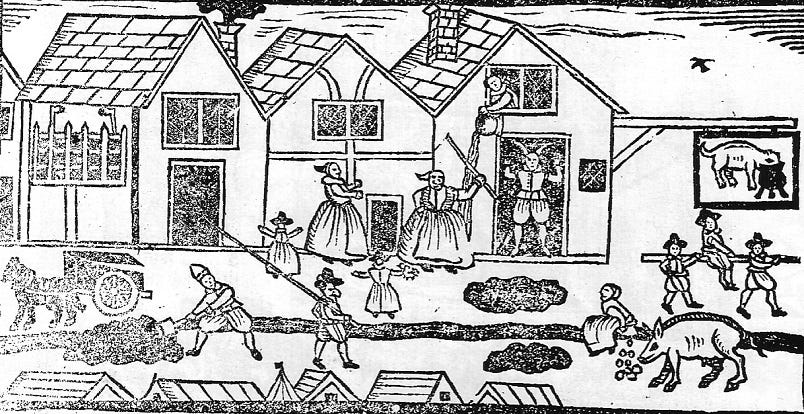
A street scene from Tudor times – apparently the era from which the entity came.
After discussing the message and showing it to others, including the English teacher at the high school, the three decided to write back:
IN THE REIGN OF QUEEN ELIZABETH THE SECOND.
DEAR LW. THANK YOU FOR YOUR MESSAGE. WE ARE SORRY FOR DISTURBING YOU.
WHAT WOULD YOU LIKE US TO DO? DID YOU LIVE IN A HOUSE ON THIS LAND IN ABOUT 1620? DO YOU WANT US TO TELL YOU MORE ABOUT OUR TIME? WHY WRITE A POEM? WHO IS EDWARD GREY? IS HE RELATED TO THE EGERTON FAMILY? DO YOU HAVE A FAMILY? IS THE KING JAMES OR CHARLES STUART? WHAT IS THE CHARGE HOUSE?
WAS THIS VILLAGE CALLED DODLESTON IN YOUR LIFE AND HOW MANY FAMILIES LIVED HERE? THANK YOU VERY MUCH FOR YOUR MESSAGES. THANK YOU FOR NOT MAKING US AFRAID.
-KEN, DEBBIE AND JOHN
The trio then left the house for the pub, hoping that in their absence another message would appear. It did:
TWAS AN HONESTE FARME OF OKE AND STONE IT IS HELPFUL THAT YOU SHOULD TELLE ME ABOUT THY TIME DOST THOU HATH (?) HORSE
EDMUND GREY, BROTHER OF JOHN GREY LIVES AT KINERTONE HALL(?) THY KYNG, OF CORS, IS HENRY VIII WHO IS SIX AND FORTIE
I NE WOOT OF KYNG JAMES
MYNE CHARGE HOUSE IS A PLACE OF LOORE SCHOOLING,
L.W.
28 MARCH ANNO 1521 (?)
Dost thou hath horse?
So. According to whatever was writing the messages, the King was Henry VIII, 46 at the time, the local lord was Edmund Grey, and the year was 1521. It appeared that, if this was a ghost, it did not seem to know it was dead. Further, whoever was contacting them seemed to think that Ken, Debbie and Nick were the interlopers.
Except…it was all wrong. Henry VIII was not 46 in 1521, and no records of an Edmund Grey seemed to exist. Why would a hoaxer write such easily debunked falsehoods?
Gradually, over a series of messages, more information was uncovered. The writer’s name was apparently Lukas Wainman, he was a rural farmer who had lived in a house on the site, and his knowledge seemed to be a confusing mix of facts and lies. Either he didn’t seem to actually know much about current events, or he was attempting to trick them on purpose. For example, he told them he’d been to Jesus Collage, Oxford, even though it wasn’t founded until after his death, apparently in an attempt to catch them out, as if he thought that they were the hoaxers.
They continued to swap messages with ‘Lukas’ through the computer, and all of this was a fascinating curiosity, until one message which only added more fuel to the fire of the mystery. ‘Lukas’ wrote to Ken one day:
YOW SAYD YOWR TYME BE 1985 ME THOUGHT YOW WERE ALS FROM 2109 LIKE YOWR FREEND WHOM DIDST BRINGE LEEMS BOYSTE PREY
Now, it seemed, a second character had been added – a person communicating with Lukas not from 1985, but 2109. Not only had the computer relayed messages from the past – it was apparently connected to the future as well.
The future (according to the 1980s)
Ken made a callout to ‘2109’ and got this response:
KEN, DEB, PETER WE ARE SORRY THAT WE CAN GIVE YOU ONLY TWO CHOICES
1) THAT YOU EITHER HAVE YOUR PREDICAMENT EXPLAINED IN SUCH A NON-RHYME WAY THAT YOU MAY HAVE INSTANT UNDERSTANDING BUT CAUSE WHAT SHOULD NOT BE TO HAPPEN< OR
2) TRY TO UNDERSTAND THAT YOU THREE HAVE A PURPOSE THAT SHALL IN YOUR LIFE TIME CHANGES THE FACE OF HISTORY, WE, 2109, MUST NOT AFFECT YOUR THOUGHTS DIRECTLY BUT GIVE YOU SOME SORT OF GUIDANCE THAT WILL ALLOW ROOM FOR YOUR OWN DESTINY. ALL WE CAN SAY IS THAT WE ARE ALL PART OF THE SAME GOD, WHAT EVER HE, IT (?), IS
The phenomenon around the house continued as well. In May 1985 Debbie came home one morning to discover all the furniture had been stacked in the corner – again, a common occurrence in poltergeist cases. ‘Lukas’ was also leaving messages on pieces of paper as well, in the same archaic language.
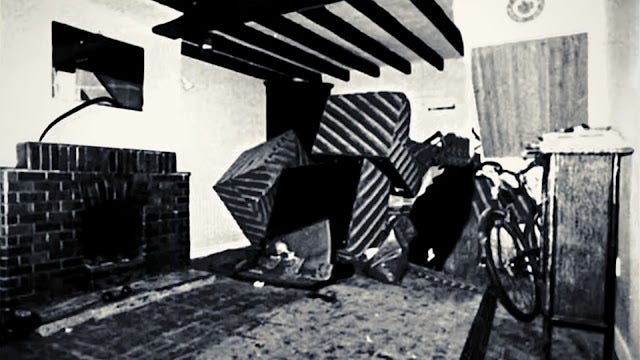
The cottage furniture piled in a corner
Ken and crew decided it was time to call in expert help, and wrote to the SPR, who sent two investigators, John Bucknall and Dave Welch. The two investigators decided to directly address ‘2109’ and ask the future some questions, then immediately deleting them so that Ken would have no idea what had been said. A few days later, he contacting the SPR to let them know a reply had arrived…
DAVID, JOHN.
DAVID. YOU INTERFERE WITH COMMUNICATION.
NEXT TIME YOU DECIDE TO PERFORM YOUR LITTLE EXPERIMENT YOU MUST BE CLEAR FROM HERE. WE SUGGEST YOU TRY SOMEONE ELSE TO SIT WITH DEBBIE.
YES WE ARE WHAT YOU WOULD CALL A TACHYON UNIVERSE BUT YOUR UNDERSTANDING IS INCORRECT.
WE ASK NOTHING MORE OF YOU THAN TO CARRY ON AS YOU WOULD PREFER. WE WILL HAVE JOHN PRESENT IF GIVEN
CHOISE OR YOU MAY BRING ANOTHER AS MENCIONED.
NO, IT IS NO CONCERN TO US THAT THIS IS NOT PROVED. WE WILL GIVE YOU A PLOTTING OF A STAR NEXT TIME.
WE MOVE AT A SPEED SO THAT WE COVER EVERY POINT IN
YOUR TIME AND UNIVERSE.
WE HAVE NO FORM WE FEED OF A NEET ENERGY THAT YOU WILL NOT HAVE HERD OF.
2109
The introduction of this writer from the future had only served to complicate things. Apart from this message, however, the SPR experienced no phenomena and were sceptical about the whole case. 2109 was also asking them to bring in a UFO researcher named Gary Rowe, who, it turned out, was a real person, and who embarked on a private communication with 2109, which ended with Gary leaving the cottage, never to return. It was all getting very confusing…
On top of this, Lukas had revealed that his ‘real’ name was actually ‘Thomas Hawarden’. Then, whoever was sending messages from the 16th century apparently changed. The writer from the past was insisting that they were now actually a friend of Thomas’s (nee Lukas), who had been arrested for witchcraft (due to his ‘light box’ communications)
The messages between Ken, Thomas’s friend and 2109 continued until, in March 1986, this ‘friend’ wrote one last message:
“MY TRUE FELLOWS AND SWEET MAID. GROSNER HAS SAID THAT THOMAS MUST GO. I KNOW IT IS FOR THE BEST BECAUSE THE PEOPLE OF DODLESTON ARE VERY WARY OF ME. IT IS GOOD TO KNOW THAT ALL WILL CHANGE AND THERE ARE TRUE MEN TO FOLLOW LIKE KEN AND PETER. THOUGH 400 YEARS IS A LONG TIME AND THERE IS SO MUCH TO HAPPEN TO MANKIND. PERHAPS YOU WILL COME TO OXFORD. NOW I THINK THERE IS NO DANGER FOR ME THERE, FOR I HEAR THE KING IS VERY SICK AND ALL IS QUIET IN THE CHURCH. I SHALL GO BY BOAT FROM CHESHIRE TO BRISTOL. I SHALL TRY TO MAKE MY STAY AT BRASENOSE. I WILL WRITE MY BOOK ABOUT MY BROTHERS AND MAID AND THE END OF LUCAS AND OUT LOVE FOR ONE ANOTHER. ONE DAY YOU WILL ALL SIT DOWN AT MY TABLE FOR WINE AND MEAT BY THE RIVER IN OXFORD WHERE WE SHALL READ EACH OTHER’S BOOKS AND LAUGH AND WE SHALL SPEAK OF TRUTH AND GOOD MEN. WATCHING OXFORD CHANGE TOGETHER, FOR EVERMORE. IN YOUR TIME MY BOOK IS OLD BUT I SHALL NOT GO TO MY GOD UNTIL IT IS WRITTEN. THEN WE WILL ALL BE TRULY EMBRACED.
MY LOVE TO YOU ALL.
I SHALL AWAIT YOU IN OXFORD.
TOMAS HAWARDEN
Followed by a last message from 2109:
THERE IS ANOTHER PERSON TO COME, THEY WILL BE THE HELP WE NEED. YOU WILL KNOW THEM WHEN THEY COME.
THOMAS DID EVENTUALLY WRITE HIS BOOK AND SOON DIED, SHORTLY AFTER, HE PLACED IT IN A SECURE PLACE, IT SHOULDN’T TAKE TOO MANY YEARS TO FIND IT, THOUGH HE WROTE IT IN LATIN WITH THE HELP OF A FRIEND THAT HE MET IN OXFORD, THE INSCRIPTION READS
“ME WRYTS THIS IN THE HOPE THAT MYNE FELAWS WILL ONE DAY FIND THIS BOKE, THEN MAY OWER LANDS BE NOT SOE DISTANT”
WE WILL FINISH NOW. YOU HAVE A LOT OF WORK TO DO.
THERE IS NO NEED TO WRITE BACK AS WE WILL HAVE GONE.
THANK YOU FOR YOUR COOPERATION.
2109
No book was ever found that matched his description, and to date Ken and Debbie have never again heard from either the past or the future. Ken discovered that there apparently was a real man with the same name, who was a vicar in Gloucestershire from 1551-54.
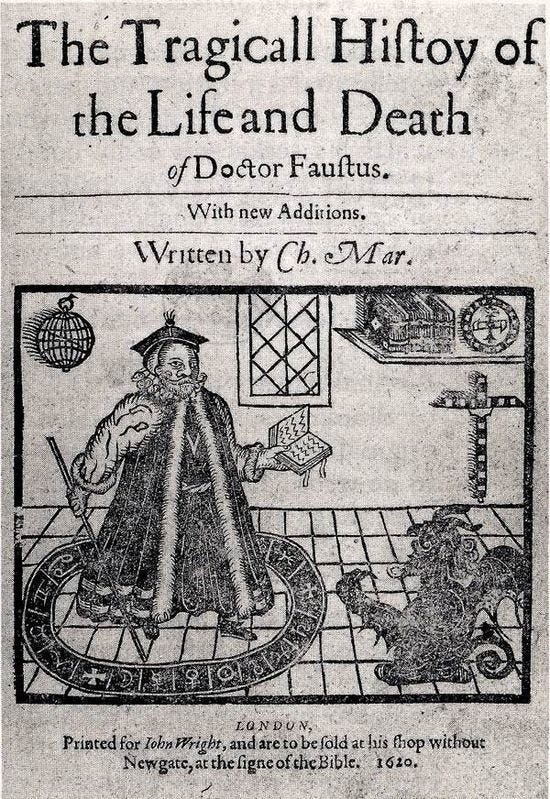
Dr Faustus, another (fictional) Tudor who attempted to contact other worlds…
So…what on earth was going on here? Time traveller, Tudors, messages from the future and literal ghosts in the machine. It’s a lot to unpack. If it was confusing to read, it was just as confusing to research! The spine chilling opening of the story, with ghostly footprints and messages from the past, soon gives way to a rather bizarre series of sci-fi events and an ever growing cast of characters. Of course, there is the distinct possibility that the whole thing was cooked up by Ken and Debbie for a bit of publicity – the SPR researchers either had their names changed to protect their identities, or potentially they never existed, and really we only have Ken’s word, from his later book, for the whole thing. A Cambridge academic studying the writing from ‘Thomas/Lukas’ concluded that, to the untrained eye, it looks authentic, but to anyone who does read early modern English, much of it is nonsensical.
I think what’s interesting about this case (hoax or not) is the way it mirrored fears around new technology at the time. Having a BBC computer in the house would have been the 80s equivalent to having AI or VCR tech now, a real novelty that unnerved some simply by existing. The story of the Dodleston messages serves as a fable to remind us of the dangers of inviting these new and unknown electronics into the house. There is also, perhaps, a nostalgia for a ‘simpler’ time before technology, as well as fears about what the future could bring. Apparently, in the year 2109, we will still be using 80s tech to keep in touch, which I find pretty scary…
If it was nothing more than a common or garden poltergeist, the entity had certainly employed some classic techniques: taking on multiple personas, making promises that were never fulfilled, and muddling up or simply lying about the facts. We may never know what really happened in Meadow cottage.
Next time: For our last article, its the home town source of all my childhood nightmares…
Liked this? Support me on with the price of a coffee here or buy a ticket to haunted house
Eleanor’s Top Ten Hauntings of All Time | #10 Mary King’s Close, My Own Personal Nightmare
In honour of my Fringe Show Haunted House, I’m doing a top ten real life hauntings run down, and for the last instalment, I’m going local.
When I was in primary school, aged maybe 8 or 9, we did a ‘history of Edinburgh’ project. It’s fairly standard in UK primary schools to do a project on your home town and its past. Edinburgh has been a settlement for thousands of years, and my primary school was on the site of Roman ruins (our school badge was a Roman ship). What made our project different from most, however was how dark and horrific Edinburgh’s history is. I can say with absolute confidence that it was a traumatising experience. Every city and town in Britain has a dark side, but Edinburgh seemed to be entirely constructed of them. Plague. Invasions. Beheadings. Hangings. Witch burnings. Murder. Body snatching. Open air prisons. Free flowing sewage. Poverty. Even our own queen, Mary, witnessed her husband and his cronies stabbing her friend David Rizzio to death. The hand drawn cover of my own project (which I’m trying to find!) included a witch being burned at the stake (contrary to popular belief, witches were usually strangled before death, burning alive was usually reserved for heretics in places like England) and a man being hanged. And those are just Edinburgh’s provable horrors – they have nothing on the myriad myths, legends and ghost stories that have sprung up over the centuries. How about the tale of the violently insane Marquess of Queensberry, who allegedly killed and spit roasted a kitchen boy in 1707? Or Major Weir and his sister Grizel, who were executed for worshipping the devil and partaking in incest? Or the plague fields that became the Meadows, a picturesque park full of cherry blossom?
The culmination of this primary school project, after a visit to the more historically sound Gladstone’s Land was a trip to Mary Kings Close. Nowadays, Mary Kings Close is fully open to the public – it has tour guides, exhibitions and a gift shop. In the early 2000s however, Mary Kings Close was nothing more than a series of abandoned streets and rooms under the City Chambers, Edinburgh’s council building on the High Street (or Royal Mile, as its more commonly known). It was inaccessible to the public, and you had to get permission to enter (and a key) from the council. A student from Edinburgh uni would then show you round for free (well, a tip). There was no lights, no information boards, no definitely no café.
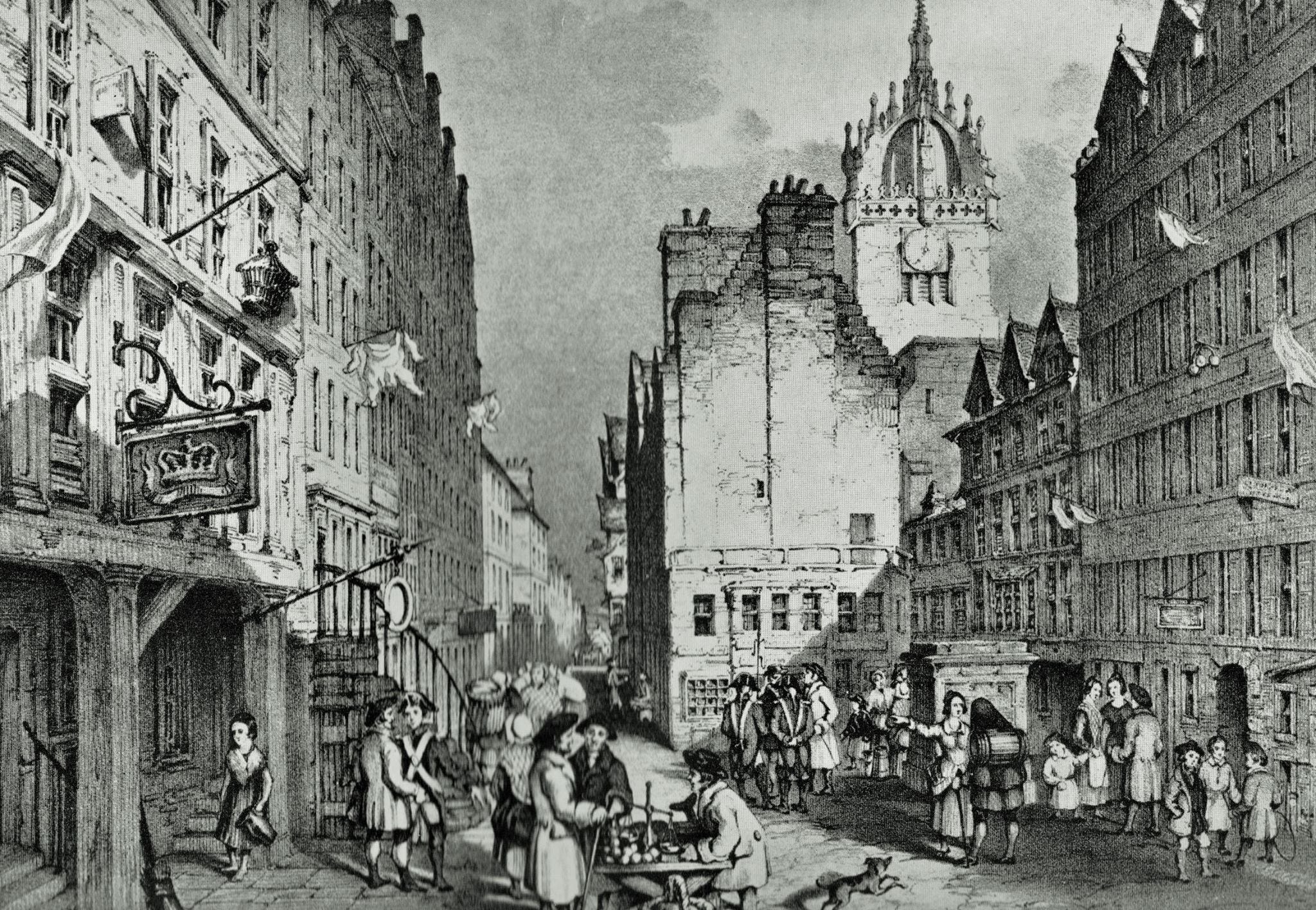
An 18th century depiction of the Old Town, looking down from the High Street, with the Castle behind us. Mary King’s Close is towards the back on the left, roughly opposite St Giles (the kirk with the tower)
As a young child I found it hard to wrap my head around the idea that there were streets below the streets. I knew from the project that Edinburgh had been built on top of itself (fear of invasion meant all building work for several centuries took place within the very narrow confines of the city wall) but I couldn’t really picture it.
I remember entering the building, from an inconspicuous side door on Cockburn Street, and being taken into the labyrinth of rooms and tunnels. Our guide, who was probably only about 20 but seemed much older to me, then proceeded to relay a series of horrifying tales about the Town Below the Ground. There was Annie, the ghost child who haunted one of the rooms, and for whom several dolls and stuffed animals had been left. There was the poor chimney sweep boy who became trapped up one of the close’s narrow chimneys and starved to death. His bones were only recovered years later, and his pitiful cries for help still echo throughout the halls. Then there was the couple who moved into the close on very cheap rent, after it had been used to store dead plague victims, and who became haunted by floating, dismembered body parts which eventually chased them from their new home.
I couldn’t sleep for weeks after the visit. I became convinced that, if I closed my eyes, my suburban bedroom would somehow morph into the close, and there I would be, trapped under ground. My nightmares were so bad I vowed never to set foot there again. Of course, as I got older, the fears died away, and I have been back to the now much more commercially appealing Mary King’s Close in recent years. But I can never forget just how much terror my initial visit instilled in me.
So, what’s the real story of Mary King’s Close and its ghosts?
First of all, the name of this ‘underground city’ needs unpacking. A ‘close’, in the Scots language, is a narrow street akin to an alley. It can also refer to the stairway inside a tenement building, or even a full sized street. Most of the closes off the High Street are named either for the trade its associated with, or a specific person who lived there – for example, Fleshmarket Close (meat industry) Old Fishmarket Close, Advocates Close (originally leading to the house of the Lord Advocate), Bakehouse close, etc etc
Mary King’s Close, therefore, was named after Mary King, a woman who lived in the close in the 17th century, and who’s family were long associated with the area. Naming a close after its inhabitants was an easy way of locating people and businesses if you couldn’t read a map, or, in this case, a way of commemorating them.
The Close itself was built sometime in the 16th century, with more buildings and alleys being added over the next century or so. According to this website, Mary Queen of Scots stayed in a house in the close belonging to the Lord Provost Sir Simon Preston, on her last night in Edinburgh in 1567, before she was taken as a prison to Loch Leven castle.
The Close, like all of Edinburgh’s streets, would have been noisy, crowded and full of life. There would have been family homes, businesses and trades like butchers, shoemakers and even livestock all squeezed into fairly compact spaces. Even class would not have separated folk much – there simply wasn’t enough room for anyone but the very rich to remove themselves from the general population, and so middle classes and working classes would have lived practically side by side.
So why was the Close so cramped? Well, as mentioned before, Scotland was under constant threat of invasion from the English, and almost everything in Edinburgh was built within the city walls – which basically only extended down and around the High street. Think of it like a spine with each close and wynd as a rib – there was nowhere else to build, unless you wanted to expose yourself to attack outwith the city’s walls (which still exist and which you can see at various points in the old town, stretching all the way to Heriot’s School).
As well as this, the northern side of the city was bordered by the Nor Loch (North Lake), now Princes Street Gardens. ‘Loch’ was a generous description; it served as the city’s drinking supply, sewers and dump.

This etching of Edinburgh from above shows the ‘spine’ building plan, running from the castle at the top to Holyrood palace at the bottom. Mary King’s Close is roughly opposite the Kirk on the upper half of the page, (north) just above the Nor Loch.
Life in the Close would have been hard. As well as poverty and fear of invasion, Edinburgh, like most towns in Europe during the Early Modern Period, was visited numerous times by plague outbreaks, the most recent and serious of these in the 1640s. There was no cure for the plague (probably bubonic) and fear and superstition around the disease would have been high. It would have smelled pretty bad, been dark and damp, and overall, not Edinburgh’s premium destination.
One enduring myth about the close is that it was bricked up with living plague victims still inside, and these victims were left to starve to death, their wails and cries for help unheeded. As sensational and gruesome as this story is, its not true. People would have been quarantined to their homes, but they were not bricked up, and were visited regularly and fed by plague doctors (not that they could do much).
In 1760, the close was partially demolished and buried by the building of the Royal Exchange (now the city chambers) and became a warren of underground rooms and buildings.
(Some of this info is from Wikipedia links to an archived post from the MKC website, which shows that back in 2011, adult tickets were £12.95 – they’re £25 today!!!)
From their website, a map showing the size of the close and the adjoining buildings/rooms. All of this is now covered over. The Cockburn street door from where I entered in primary school is at the bottom of the close. The top door leads to the High Street.
By the 18th century, the Act of Union with England had been established, and there was no need to keep building inside the city walls. Gradually, Edinburgh spread out into the ‘New Town’, an impressive Georgian project which turned Edinburgh into a sophisticated and modern capital. The Nor Loch was drained, and the city became a popular tourist destination (that hasn’t changed). It even came to be known as the ‘Athens of the North’. Having never visited actual Athens, I can’t tell you how accurate this is, but I suspect Greece is a lot less chilly and grey.
Carlton Hill’s classical style New Town buildings helped cement Edinburgh’s new reputation as a beautiful and classy city.
And so, the Old Town fell into a state of disrepair. It was not subjected to the modernisation of the New Town, and became the haunt of much of Edinburgh’s poorest, including Irish and Highland immigrants. It garnered a seedy reputation for crime, sex work and the night time activities of body snatchers like Burke and Hare. In this unstable and unsafe warren of crumbling buildings, fires were common, as were accidental deaths. The poor crowded into the ‘vaults’, a series of storage rooms built into the new South Bridge, and overcrowding and unsanitary conditions were rife. In fact, the Old Town’s unfashionable reputation remained until all the way into the mid 20th century – my high school music teacher, who grew up on the High Street, told me it was akin to a scheme (council estate) in terms of reputation. Now, of course, it’s insanely popular as a tourist destination, although in my mind its never quite shaken its slightly run-down vibe – perhaps due to the overwhelming amount of tacky, rather depressing tat shops it harbours. Although where else can you get your Princess Diana Memorial Tartan? (Tourists please note: buying a see you Jimmy hat with fake ginger hair is a hate crime, and if I see you in one, I will slap if off your head).
Mary King’s Close was essentially forgotten, until building work in the 1930s unearthed many of the lost rooms of the Close.
NB: It’s hard to pinpoint exactly when people stopped living in the Close – some sources claim it was buried and forgotten after the Chambers were built, but there are records of people hanging out in pubs in or near the Close in the 18th century, as well as a resident being there as late as 1901. As far as I can tell, the Close was no longer permanently inhabited after the 1760s, but traders continued to use the workshops there until the end of the 19th century, when only one craftsman, the sawmaker Andrew Chesney, remained.
What was found was essentially a moment frozen in time – belongings, tools and personal items from the 17th century – even wallpaper – still remained in the Close. Fascination grew and eventually it was opened as a tourist attraction in 2003, only a few years after my school visit. I wish now that I’d been able to appreciate just how special and significant our visit to this truly unique place had been.
So…what of the ghosts?
In the years after Mary King’s Close was abandoned, it gained a reputation as haunted. Most of these ghost stories, including the ones I mentioned at the beginning, have vague and somewhat mythical origins.
One of the sources for the ghost tales of Mary King’s Close is George Sinclair’s succinctly titled Satan’s Invisible World Discovered: Or, a choice collection of modern relations, proving evidently, against the atheists of this present age, that there are Devils, Spirits, Witches, and Apparitions, From authentic Records, and Attestations of Witnesses
of undoubted veracity. That’s right, it’s another spooky pamphlet with an overlong title; I just can’t get enough.
Sinclair (1630-196) is described by Wikipedia as ‘a mathematician, engineer and demonologist’ which tells you all you need to know about science in the 17th century. Satan’s Invisible World is less a treatise on the realities of belief and spiritualism and more a bumper book of ghost stories, one of which was told to me as a child in the very room it supposedly occurred.
According to Sinclair, a Thomas Coltheart and his wife were preparing to move into the close (presumably at some point in the 17th century) when their maid was spooked by a friend who told her that if they did move to the close they would have ‘More company than yourselves’.
On their first night in the close, the Colthearts were reading (the Bible, obv) in bed, when Mrs. Coltheart glanced up and saw the disembodied head of a man floating in front of the fire place. This was followed by ‘a young child, with a coat upon it, hanging near to the old man’s head’ and the couple immediately leapt out of bed and started to pray.
Praying didn’t seem to help – the next thing to materialise was an arm, attached to nothing, which only heightened their fear. The arm itself, however, was friendly; it attempted more than once to shake hands with Coltheart, who apparently declined. Fair enough.
The most remarkable part of the tale is skipped over – after these disembodied apparitions, there comes the groans of a dying man, and then Sinclair goes to on say that the hallway outside their bedroom was ‘full of small little creatures dancing prettily; unto which none of them could give a name, as having never in nature seen the like.’ Sinclair doesn’t bother to describe the creatures in any way, and so they remain a tantalising mystery.
The Coltheart’s remained in the house until Mr Coltheart died a short while later, confident to their last that God would protect them from whatever the hell was happening.
As with the pamphlet on the Mackie Poltergeist, which I explored in an earlier article, the aim of this gruesome tale seems to be to convince the belief both in the existence of spectres and the power of God. Some context was also added to the story when it was retold to me as a child: the body parts, as I mentioned earlier, where those of plague victims of the Close, who had been chopped into pieces to make for an easier removal. Gross.
Other, less fleshed-out (pun intended) stories about the Close include Andrew Chesney, the last resident in the Close, who was forced out by the council in 1901 – yup, in the 20th century. His disgruntled ghost is supposed to haunt the Close, presumably to complain about council tax rates. There’s also a classic Woman in Black, who is said to scratch visitors with unseen hands.
‘Annie’s doll’ is probably the story with the most recent origins. In the 1990s, Japanese psychic Aiko Gibo visited the Close and claimed she had connected with the ghost of a child, Annie, who had lost her doll and was upset. Aiko went out to the nearest shop and bought Annie a tartan-clad Barbie, which seemed to appease her, and to this day, people leave dolls and toys in the location known as ‘Annie’s Room’ within the Close. I distinctly remember being in this room as a kid, with no lights except our guide’s torch, and the odd sight of a pile of dusty dolls and teddy bears piled in the corner.
Personally, I’m not particularly interested in Annie’s story. I’m always a little sceptical when a medium shows up and declares a ghost- with no previous legend – to exist. So far no records have turned up an ‘Annie’ living in the Close. Plus there is something weirdly morbid about the heap of toys and dolls that has accumulated over the years. And I can’t help thinking about the vulnerable children of Edinburgh who might have appreciated those toys more than a ghost – you can donate toys to Edinburgh’s children’s hospital here, for instance.
Mary King’s Close, unlike most of the ghost stories I’ve covered in this series, is less a tale that reflects the fears of contemporary readers, and more a warning from the past. It’s literal status as buried history reminds residents and tourists alike of the horrors of poverty and the past, and suggests there was something base and animalistic about the way our ancestors lived that we have somehow evolved out of. Of course, this isn’t true – the inhabitants of Mary King’s Close were simply the victims of something scarier than ghosts – poverty.
If you liked reading about Mary King’s Close and its history, the good news is that my Fringe venue is only a 4 min walk away, on the other side of the Mile, in another set of underground rooms.
And if you want to hear me talk more about Mary King’s Close, I was a guest on the Loreman Podcast recently, which coincidentally focused on the Close the very same week I wrote this article! Spooky!
Thank you for going on this haunted journey with me – I’ve really enjoyed getting the chance to write and research all of these favourite stories from my childhood!
Liked this? Support me on with the price of a coffee here or buy a ticket to Haunted House!
 Eleanor Morton